


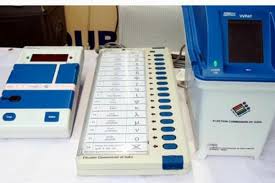
 The Chief Bench of the Madras High Court has deferred the plea filed by the DMK against the design of the third-generation (M3) electronic voting machine (EVM) to June 25. The ruling party informed the court that it is pressing the request for future elections and not for the upcoming Parliament election.
The division bench, comprising Chief Justice SV Gangapurwala and Justice J Sathya Narayana Prasad, questioned DMK on why the petition was filed at the threshold of the election. Senior counsel NR Elango, representing the party, stated that the Election Commission of India (ECI) published the handbook in January, and despite various representations, no action has been taken.
Elango clarified that the plea is not for the imminent Parliament election but for elections to be conducted in the future. He argued that the placement of the voter-verifiable paper audit trail (VVPAT) between the balloting unit and control unit in the M3 EVM contradicts rule 49 P of the Conduct of Election Rules, 1961.
Additionally, Elango raised concerns about the ECI granting limitless power to the returning officer and sought guidelines under Rule 95 of the Conduct of Election Rules to regulate the handling of EVMs.
The standing counsel for ECI defended the use of the M3 EVM, stating that it has been deployed since 2013 in a phased manner. The counsel highlighted that the M3 EVM was utilized during the 2021 assembly election in the State without any dispute raised by the DMK, and they emerged victorious in the election.
DMK’s organizing secretary RS Bharathi filed a writ petition in the High Court seeking direction to the ECI not to place the printer between the balloting unit and control unit in the third-generation electronic voting machine. The petition argued that this arrangement opens up technical possibilities to corrupt the integrity of the data fed to the control unit.
The petition emphasized that the rules mandate direct contact between the balloting unit and control unit of the EVM, prohibiting the printer from being in direct connection with the control unit.