


In yet another setback, the Congress party has once again faltered in a direct electoral contest with the BJP, this time in Haryana. Despite high hopes of capitalizing on anti-incumbency against the 10-year rule of the BJP, the Congress was able to secure only 37 seats in the state assembly. Meanwhile, the ruling BJP, under the leadership of Chief Minister Nayab Singh Saini, achieved a historic victory by winning 48 seats, marking a remarkable hat-trick in the state.
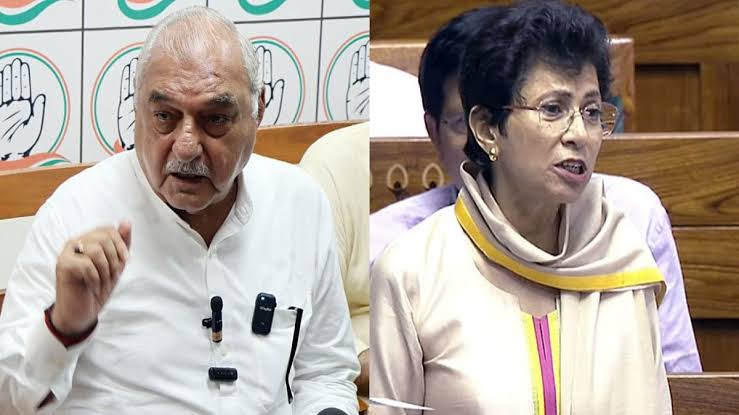
The reasons for Congress’s dismal performance in Haryana are many, but factionalism within the party stands out as one of the most significant. The Congress leadership placed the reins of the election strategy entirely in the hands of Bhupinder Singh Hooda, former Chief Minister and a dominant Jat leader in the state. This move sidelined other prominent leaders, most notably Kumari Selja, a key Dalit face of the party.
Selja, feeling marginalized in the decision-making process, particularly in ticket distribution, distanced herself from the campaign. Her absence provided ample fodder for the BJP, with Prime Minister Narendra Modi and other party leaders seizing on the narrative of a “disrespected Dalit leader” within Congress. The BJP effectively leveraged this discontent, portraying Congress as neglecting the interests of the Dalit community, a crucial voter base in the state.
While Selja eventually reaffirmed her loyalty to Congress after a meeting with party president Mallikarjun Kharge, the damage had already been done. Her participation in the campaign remained lukewarm, reduced largely to symbolic appearances rather than active engagement. The Congress leadership, instead of mending the rift between Hooda and Selja, allowed the divide to persist, further weakening the party’s campaign.
Another major factor behind the Congress’s failure was its over-reliance on Hooda’s leadership. His dominance led the party to heavily focus on the Jat vote bank, which, although significant, represents only around 26%-28% of Haryana’s population. This narrow approach alienated non-Jat communities, including Dalits and OBCs, who felt overlooked in the Congress’s campaign messaging.
Moreover, Rahul Gandhi’s controversial comments about reservations further fueled discontent among marginalized communities. His remarks, interpreted by some as suggesting a reduction in quotas for reservations, were quickly exploited by the BJP, which cast the Congress as indifferent to the concerns of Dalits and OBCs.
Compounding the party’s internal issues was the fragmentation of opposition votes. The presence of smaller regional parties like the Indian National Lok Dal (INLD) and Jannayak Janta Party (JJP) split the anti-BJP vote, preventing a united opposition front. This division worked in favor of the BJP, allowing it to consolidate its voter base while the opposition remained fragmented and disorganized.
The BJP’s superior organizational strength and clear messaging further bolstered its chances, allowing it to navigate the complex caste dynamics of Haryana and secure victory in key constituencies. In contrast, Congress’s campaign lacked the cohesion and clarity necessary to challenge a well-oiled electoral machine like the BJP’s.
In the aftermath of the defeat, Congress leaders, including Kumari Selja, have called for introspection. Selja’s statement that “it will not be business as usual after the disappointing loss” reflects the growing discontent within the party and the need for serious reforms. Whether the Congress can learn from its missteps and rebuild itself remains to be seen, but for now, the defeat in Haryana serves as a harsh reminder of the challenges the party faces on its road to revival