


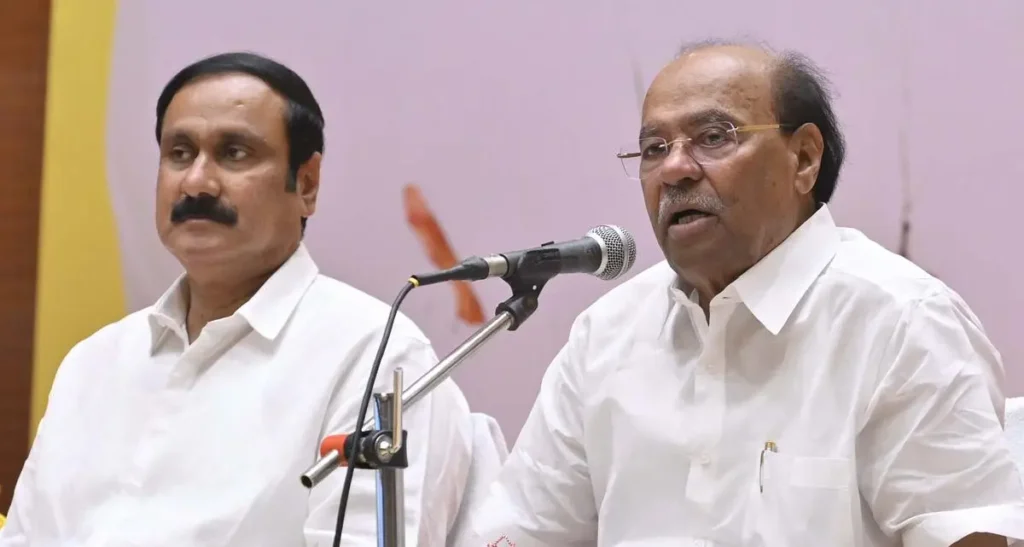
 The Pattali Makkal Katchi (PMK), a key political player in Tamil Nadu, is witnessing an unprecedented internal crisis as tensions escalate between its founder Dr. S. Ramadoss and his son Dr. Anbumani Ramadoss.
What began as a disagreement over electoral alliances has now transformed into a bitter public rift, with strong emotional and political overtones.
In a shocking statement, Dr. Ramadoss declared that it was not Anbumani who erred, but he himself. “The mistake was not made by Anbumani. I am the one who made a mistake by making him a Union Minister at the age of 35, even going against my own oath and principles,” he said. This confession highlights the deep regret and disillusionment Ramadoss feels about his decision to elevate his son in national politics, suggesting that his trust had been betrayed.
The veteran leader went on to accuse Anbumani of attempting to paint him as the wrongdoer in front of the public. “He questioned me in front of the people as if I had done something wrong and made me the accused. Now I am forced to respond,” he said. According to Ramadoss, Anbumani’s remarks are not just personal attacks, but a deliberate strategy to shift the focus away from his own missteps and seek public sympathy. “By making me the villain, Anbumani is trying to win people’s support through pity,” he added.
Ramadoss also criticized his son’s recent conduct at the party’s General Council meeting in Puducherry, which was widely viewed. “The entire world saw what happened at that meeting. Who violated the decorum of the stage? Was shaking his legs on stage proper behavior?” he asked, expressing his dismay at what he perceived as immature and disrespectful conduct. He emphasized that he wishes to reveal everything openly, without concealing the truth.
Taking a more structural view of the damage, Ramadoss lamented that Anbumani had brought shame upon a party known for its discipline. “He has humiliated a party that has always been run with order and dignity. He lacks the fundamental qualities of leadership and even basic affection or regard for the party,” Ramadoss said. His remarks reflect not just disappointment in Anbumani’s leadership, but a sense of betrayal over the erosion of the values on which the party was built.
The heart of the conflict appears to be a disagreement over alliances. Anbumani is reportedly in favor of aligning with the Bharatiya Janata Party (BJP), a position his father strongly opposes. Ramadoss believes that a renewed alliance with the AIADMK would have yielded more parliamentary seats and provided a stronger base for the party. He was particularly upset with Anbumani for inviting BJP leader K. Annamalai to a key party meeting without informing him.
The fallout has led to Ramadoss demoting Anbumani from party president to working president, with the senior leader reclaiming full control. He has even hinted at calling a General Council meeting to remove Anbumani from all posts if necessary. In contrast, Anbumani has responded with apparent confusion and pain, stating that he does not know what mistake he committed, and reaffirmed his respect for his father.
This dramatic public rift within the PMK has created uncertainty about the party’s future. With Tamil Nadu gearing up for the 2026 Assembly elections, a divided PMK could weaken its bargaining power and political influence, particularly among its core Vanniyar community support base. Unless reconciliation occurs soon, this leadership crisis could have long-term consequences for the party’s identity and direction in Tamil Nadu politics.