


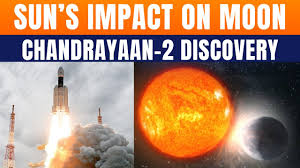
 India’s Chandrayaan-2 lunar orbiter has, for the first time, directly observed the effects of the Sun’s Coronal Mass Ejection (CME) on the Moon’s extremely thin atmosphere, known as the lunar exosphere. Using its onboard instrument, Chandra’s Atmospheric Composition Explorer-2 (CHACE-2), the mission detected a significant increase in the total pressure and density of neutral atoms and molecules on the dayside of the Moon when the CME struck.
This observation, made during a rare solar event on May 10, 2024, confirms theoretical predictions that solar storms can temporarily alter the lunar exosphere by knocking off atoms from the Moon’s surface. Unlike Earth, the Moon lacks a global magnetic field, making it particularly vulnerable to such solar phenomena.
ISRO highlighted that this finding advances scientific understanding of lunar space weather and emphasizes challenges for future lunar habitats, which must consider the impact of solar events temporarily changing the lunar environment.
This breakthrough deepens knowledge about the Moon’s surface boundary exosphere and space weather effects, offering valuable insights for upcoming lunar exploration and human settlements.
This discovery was published in the prestigious journal Geophysical Research Letters in August 2025.