


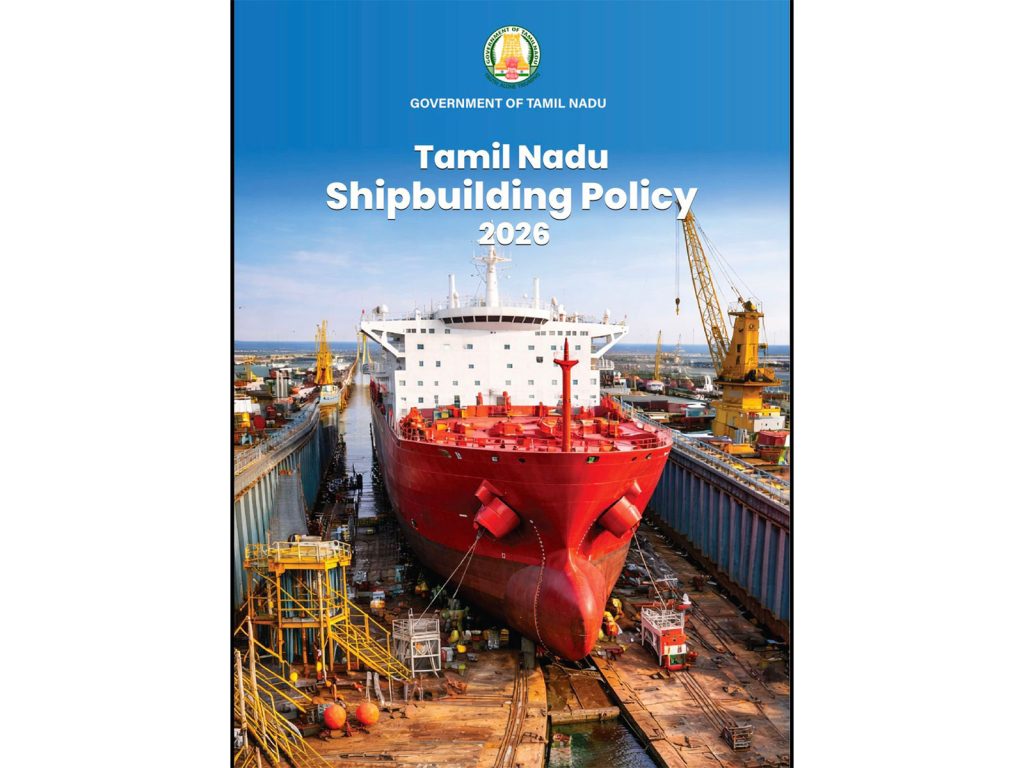
The Government of Tamil Nadu has unveiled an ambitious Shipbuilding Policy 2026 aimed at transforming the state into a major hub for large ocean-going vessels and maritime manufacturing. The policy was launched by Chief Minister M. K. Stalin at the State Secretariat in Chennai in the presence of Industries Minister T. R. B. Rajaa.
The new policy seeks to attract global shipyards, marine equipment manufacturers and mega vessel projects to the state. It aims to position Tamil Nadu as a centre for building high-value ships, including Very Large Crude Carriers (VLCCs), aligning with India’s broader maritime expansion.
Under the policy, shipyards engaged in construction, repair and maintenance of maritime structures will be eligible for a Structured Package of Assistance if they invest at least ₹1,000 crore and generate a minimum of 1,000 jobs. Qualified companies can choose from four incentive models: state equity participation, an asset leasing model, capital subsidies on eligible fixed assets with additional incentives, or production-linked incentives.
To implement the initiative, the state will create a Special Purpose Vehicle (SPV) with an independent legal identity under the State Industries Promotion Corporation of Tamil Nadu. The SPV will facilitate the development of shipyards in designated clusters by enabling seaside infrastructure supported by the Union government while land-side infrastructure will be developed by the state through SIPCOT. It will also assist investors in securing project financing.
The government may take a minority equity stake in shipyard projects either directly or through a designated agency. Cash-based equity support will initially be structured as milestone-linked debt and disbursed in stages. Once specific milestones are achieved, this debt may be converted into equity of up to 49 per cent, with further tranches released accordingly.
A key highlight of the policy is a structured asset leasing framework. Through a designated entity, the state may purchase and lease back critical shipyard assets—excluding land—valued at up to ₹6,000 crore or 20 per cent of the total project cost, whichever is lower. The government’s total annual financial commitment under this arrangement will be capped at ₹1,000 crore across projects in the state.
Under this system, shipbuilding companies may acquire essential equipment and assets based on operational requirements and later sell them to the SPV, which will lease them back on mutually agreed terms. Lease rates will be benchmarked against leading global shipyards or determined by an expert committee, taking depreciation and asset lifespan into account to ensure viable returns for both investors and the state.
The policy also offers incentives to component manufacturers. Companies investing at least ₹50 crore, supplying at least 50 per cent of their production to shipyards and generating a minimum of 100 jobs will qualify for benefits under the Tamil Nadu Industrial Policy 2021 and will be recognised under the Sunrise sector category. Investments between ₹50 crore and ₹499 crore will be classified as large projects, while those exceeding ₹500 crore will be categorised according to the norms of the policy.