


Chennai, Mar 23:
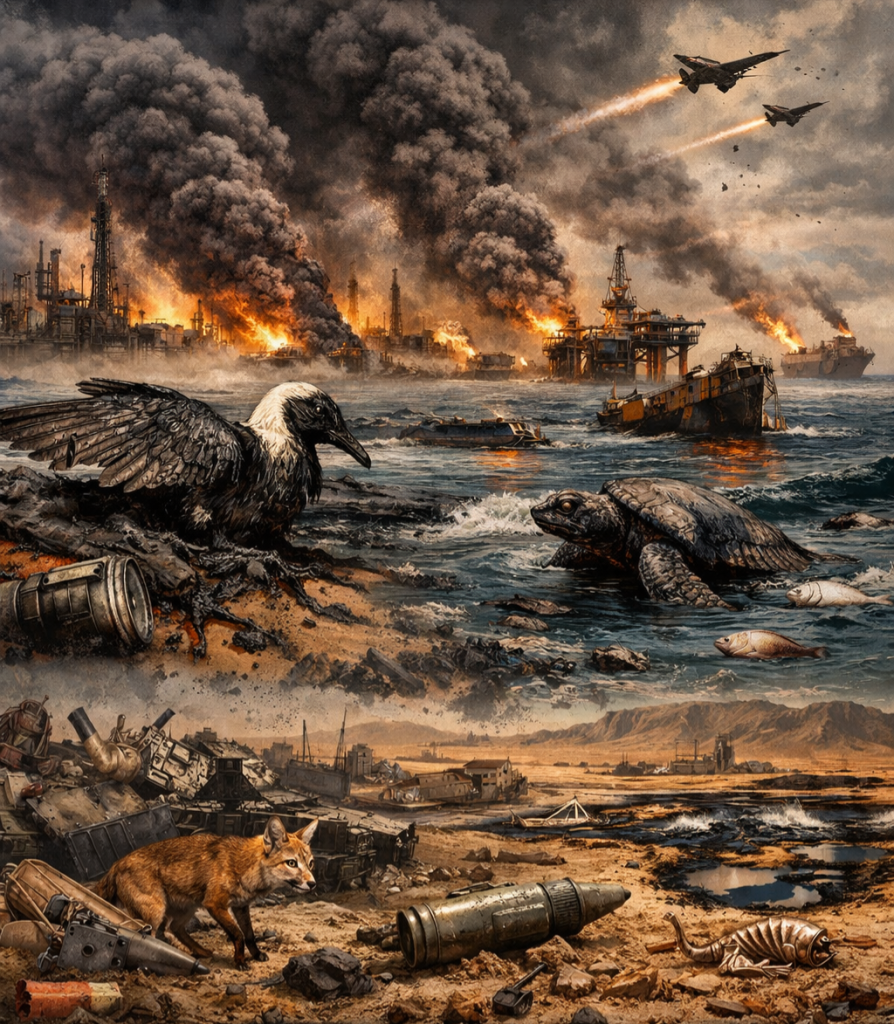
Three weeks into the US-Israel campaign against Iran, the Persian Gulf is not only a theatre of missiles and drones but a laboratory of ecological ruin.
Strikes on South Pars, the world’s largest gas field, Ras Laffan in Qatar, Saudi and Kuwaiti refineries, and dozens of tankers in the Strait of Hormuz have unleashed pollutants on a scale that echoes the 1991 Gulf War yet unfolds faster in a region already stressed by climate change and chronic oil extraction.
While headlines track oil prices and casualties, preliminary satellite data and monitoring by the Conflict and Environment Observatory reveal over 300 environmental-risk incidents.
The damage spans air, sea and land, threatens marine and terrestrial life, and carries consequences that will linger for decades.
Air Choked by Smoke & Soot
Fires raging at damaged Ras Laffan LNG facilities and Iranian petrochemical plants at Asaluyeh pour thick plumes of black carbon, sulphur dioxide and particulate matter into the sky.
Early analyses mirror the 1991 Kuwait oil fires, which burned 4.6 million barrels daily and emitted 20,000 tonnes of soot and 24,000 tonnes of SO₂ each day.
Local temperatures have dropped several degrees beneath the smoke blanket, exactly as they did then, while soot fallout creates “black rain” events reported in Tehran and coastal Saudi areas.
These aerosols, laced with heavy metals and polycyclic aromatic hydrocarbons, drift across the narrow Gulf and settle on land and water.
Scientific models from past conflicts, published in journals such as Nature and Marine Pollution Bulletin, warn that such particles reduce sunlight, disrupt photosynthesis in desert vegetation and coastal mangroves, and trigger acid rain hundreds of kilometres away.
The short-term haze already stresses migratory birds crossing one of the planet’s busiest flyways.
Seas Poisoned by Oil & Chemicals
Iranian retaliation and coalition strikes have damaged offshore platforms, loading terminals and at least 85 vessels trapped near Hormuz. The risk of large-scale spills is acute.
The 1991 war released between one and 1.7 million tonnes of crude—coating 700 kilometres of Saudi shoreline and killing 50 to 90 percent of intertidal crabs, molluscs and amphipods in affected wetlands. Today’s strikes target similar infrastructure in a sea with limited flushing.
Even modest leaks threaten the Gulf’s fragile seagrass beds and coral reefs, home to the world’s second-largest dugong population and endangered hawksbill and green turtles.
Oil smothers gills, disrupts reproduction and taints the food chain; studies after the 1991 spill found reduced turtle hatching rates persisting for years.
Sunken tankers add chronic leaks of bunker fuel and heavy metals, while underwater explosions generate noise that disorients marine mammals and damages reef structures.
The Persian Gulf’s high salinity and low oxygen already make species vulnerable; another major spill could push corals and seagrass toward irreversible collapse.
Land Scarred by Rubble & Toxins
Onshore strikes have turned industrial sites into rubble fields laced with unexploded ordnance, heavy metals and possible residues from precision munitions. Dust clouds laden with particulate matter rise from collapsed facilities and bombed depots, carrying contaminants deep into desert soils.
In 1991, oil lakes covered up to 200 square kilometres of Kuwaiti desert; similar pools now form around damaged Iranian terminals.
Weathered crude penetrates aquifers slowly, creating long-term groundwater risks documented in post-1991 monitoring.
Depleted uranium—if used in armour-piercing rounds—adds radioactive microparticles that bind to soil particles and enter the food web, exactly as observed in earlier Middle East conflicts.
Vegetation dies under tarcrete crusts, accelerating desertification in a region already warming faster than the global average.
Wildlife Pushed Toward the Brink
The Gulf’s biodiversity, already squeezed by decades of development, faces immediate and cascading losses. Seabirds coated in oil lose waterproofing and drown; preliminary counts suggest thousands affected near Qatari and Saudi coasts.
Dugongs grazing contaminated seagrass ingest toxins that impair reproduction. Fish larvae exposed to polycyclic aromatic hydrocarbons suffer genetic damage and mass mortality, as recorded in laboratory recreations of 1991 conditions.
Noise from relentless explosions and naval activity further fragments habitats—studies in Nature link underwater blasts to disorientation in cetaceans and reef fish.
On land, desert foxes, gazelles and migratory locusts ingest fallout-contaminated vegetation, with bioaccumulation climbing the food chain toward raptors and humans.
Long Shadow: Regional Recovery & Global Ripples
The damage will not end when the missiles stop. Post-1991 research shows weathered oil lingering in subtidal sediments for over a decade, with full ecological recovery still incomplete in some bays after 35 years.
Methane leaks from ruptured South Pars wells could release warming agents 86 times more potent than CO₂ over two decades, adding a measurable pulse to global emissions.
Black carbon settling on distant glaciers may accelerate melting, while acid rain and altered monsoon patterns—observed in 1991 models—threaten agriculture far beyond the Gulf.
Scientific warnings in recent assessments by the Conflict and Environment Observatory and marine-pollution journals urge urgent monitoring; without it, the war’s invisible toll could rival its human cost.
In the harsh arithmetic of modern conflict, environmental wounds heal slowest. The Persian Gulf, already one of the planet’s most stressed marine basins, now bears fresh scars that will shape its ecosystems—and the lives dependent on them—for generations.
While diplomats negotiate ceasefires, the sea, sky and sand keep their own silent ledger.