


R Chandra Mouli
“We will make weapons, we will make fine paper, We will establish factories, we will establish schools of learning, We will not rest, we will not bow our heads, We will speak the truth, and do many great deeds.”
If that sounds familiar, and you are an admirer of Mahakavi Bharathiyar, the lines in Tamil are already kindling the fountainhead of your memory. Writing at a time when the Nation was dependent on imports, Bharathiyar espoused Swadeshi as a movement, and his fiery poetry, such as the verse quoted above, emphasized the need for indigenous production.
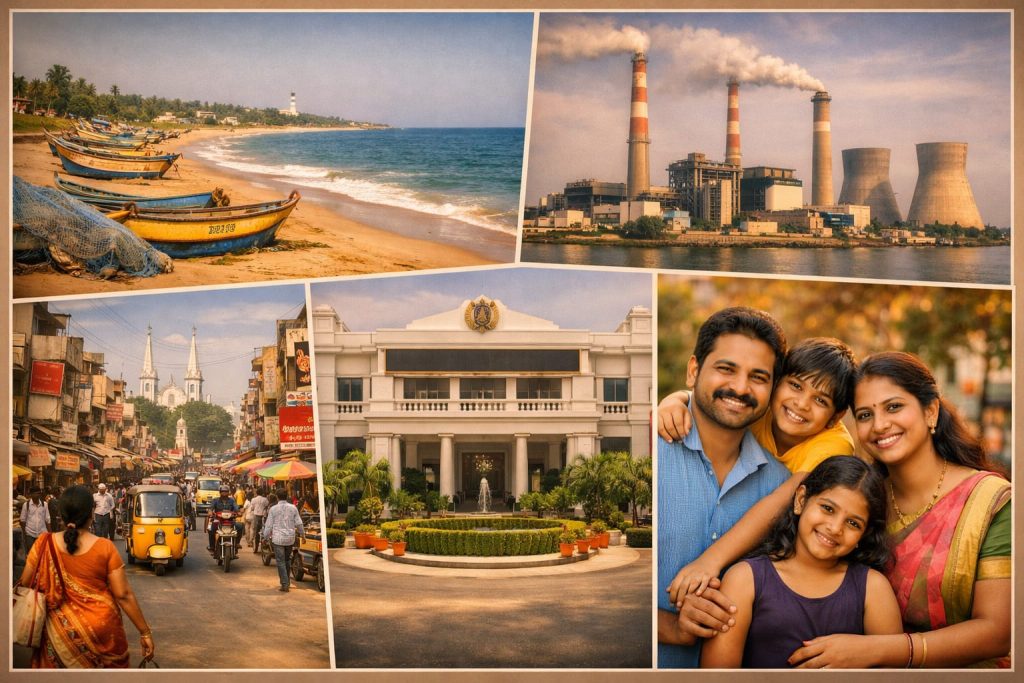
Bharathiyar hailed from Ettayapuram, which is part of Thoothukudi, a sun-drenched, windswept district on the Tamilnadu coastline, known for its contribution to the freedom struggle, legacy of pearl fishing, and as a bustling base for business and industry.
What sets the district apart is its multi-modal connectivity – by sea, air, rail, and road – which augurs well for the inward and outward movement of raw materials and finished goods. Equally compelling is its industrious workforce, largely skilled or semi-skilled, whose employability is further strengthened by extensive vocational training. Reasons why Thoothukudi is a preferred destination for overseas and domestic investors.
In February 2026, the Tamil Nadu State Government announced plans for a shipbuilding cluster to be developed in association with VO Chidambaranar Port Authority at an estimated cost of Rs. 5,200 crores.
In April, HD Korea Shipbuilding and Offshore Engineering announced the signing of an MOU and an investment plan that may earn Thoothukudi a place on the world maritime map – India’s first greenfield shipyard that will build a spectrum of ships, including large crude carriers and gas carriers. Project cost: Rs. 40,000 crore.
Such initiatives are the crest of an investment wave breaking over Thoothukudi.
Before the Koreans set sight on Pearl City, the Vietnamese had arrived. February 2024 marked the ground-breaking ceremony of Vinfast, for manufacture of Electric Vehicles at SIPCOT Industrial Complex in Sillanatham in Thoothukudi district, as part of a ₹16,000-crore investment pact between VinFast and the Tamil Nadu government. The assembly plant was inaugurated in August 2025 (market update: VinFast Limo Green all-electric taxis are now operating in Delhi and NOIDA).
As reported in the media, Tuticorin topped in investments announced at the TN Rising Conclave in August 2025: The Sakthi Group committed Rs 5,000 crore for ammunition and propellant manufacturing; Singapore-based April Fiber Resource (RGE) announced plans for investment of Rs 4,953 crore for a man-made fibre unit; South Korea’s Yeemak & Jeanuvs Rs 3,400 crore to make advanced electronics and defence components; Kaynes Circuits India Rs 4,995 crore to manufacture advanced electronic components in Tuticorin and other districts; Radha Engineering Works Rs 1,500 crore in ship, allied vessels and tug component manufacturing in Tuticorin.
In addition to the above, a series of investments by the Adani Group in Tamilnadu, specifically the district of Thoothukudi, could be a game-changer in employment generation and GDP enhancement. Here we go with an AI overview:
Cement Manufacturing: Ambuja Cements (part of the Adani Group) acquired My Home Group’s 1.5 MTPA cement grinding unit in Tuticorin for ₹413.75 crore. Additionally, the group plans to establish a 6 million tonne capacity plant in Tuticorin as part of a broader ₹3,500 crore regional cement expansion strategy.
Power Generation: Adani Power acquired Coastal Energen’s 1,200 MW coal-fired thermal power plant in Tuticorin through the NCLT insolvency process. Its subsidiary, Moxie Power, secured a five-year power supply agreement to supply 558 MW of reliable electricity to Tamil Nadu from this facility.
Port Infrastructure: Adani Ports and Special Economic Zone (APSEZ) has been actively bidding on major port development projects, including the ₹7,056 crore outer harbor project in Tuticorin.
The recap of existing and upcoming projects by domestic and overseas players reiterates the stature of Thoothukudi as a preferred investment destination. Yet the aura dims partly if we look back at the past, from the new millennium to a time when Pearl City was home to a smelter that succeeded in making India self-sufficient in a critical metal – copper.
Over a period of 8-10 years, there was a series of protests against the manufacturing facility. Was the smelter a “persistent polluter” or a victim of misinformation? This has been a matter of debate, argued in tribunals, courts and public forums.
We now have new leadership in the State. I join everyone in wishing them well. As an early step, though not part of the 40-point action plan aimed at transforming the State, Hon’ble Chief Minister C. Joseph Vijay can assimilate facts and review a restart of the copper smelter, subject to judicial, regulatory, and statutory approvals. He may take into consideration the divergent yet pertinent views of environmentalists, activists and former employees.
Closing with a concept from Physics: The world of business often compares sustained progress to the Flywheel Effect: The wheel takes a few turns to start, spins, and its velocity achieves the desired momentum. Thoothukudi’s current pace resembles this metaphor, and the key message is transformation once initiated at scale should not taper.
To drive growth for the greater good, in Thoothukudi and across Tamilnadu, our dynamic Chief Minister could take a cue from the flywheel’s framework and the words penned by a son of the soil: “We will establish factories, we will establish schools of learning, We will not rest, we will not bow our heads. We will speak the truth and do many great deeds.”
(R. Chandra Mouli is a communications strategist based in Mumbai. Views expressed are his own)