


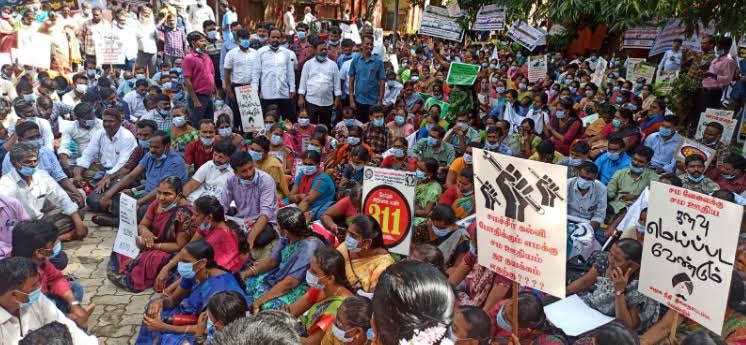
For nearly two weeks, Tamil Nadu’s secondary grade teachers have sustained a protest that is less about a single pay order and more about accumulated distrust. What began as a cadre-specific grievance has now widened into a governance question—how long can a State that prides itself on social justice tolerate a structural inequality within its own school system?
The agitation has unfolded across Chennai and district headquarters, disrupting schools soon after reopening and forcing the administration into a defensive posture. Yet this is not a sudden flare-up. It is the eruption of a grievance that has been fermenting quietly for over a decade.
The origin story: a date that divided a cadre
The dispute traces its roots to a pay fixation introduced around a cut-off date in 2009. Teachers appointed before this date were placed on a higher basic pay, while those appointed after—despite identical qualifications, responsibilities, workload and promotional avenues—were fixed at a lower scale.
At the time, the decision may have appeared technical, even administrative. Over the years, however, every pay revision, dearness allowance increase, and increment compounded the gap. What began as a difference in starting pay gradually translated into a significant disparity in monthly earnings, retirement benefits, and overall career valuation. For teachers who entered service after the cut-off, the message was blunt: you may do the same work, but your service will never be valued the same way.
What the teachers want—and what they insist it is not
The teachers’ core demand is straightforward: pay parity within the same cadre. They argue this is not a demand for a special benefit or an extraordinary hike, but a correction of an internal anomaly that violates the principle of equal pay for equal work.
Importantly, they frame their demand as retrospective justice, not retrospective payment. Many are willing to forgo arrears if parity is fixed going forward. The insistence is on dignity, not windfall.
The agitation has also been driven by frustration over prolonged consultations. Committees were formed, representations submitted, assurances offered—but without a final, binding resolution. For the protesting teachers, the issue is no longer procedural; it is existential.
Promises, perceptions, and political memory
Teachers’ movements do not operate in a political vacuum. Over the years, successive governments have acknowledged the anomaly in principle, if not in action. During election cycles, the issue has resurfaced as a talking point—implicitly or explicitly—feeding expectations that a change of regime would mean closure.
When those expectations remained unmet, the sense of betrayal hardened. In the teachers’ narrative, the problem is not merely the delay, but the erosion of trust. Each committee without outcome, each assurance without timeline, is read as avoidance rather than caution.
For the government, however, the problem is framed differently. Any decision to revise pay scales has cascading fiscal implications—across increments, pensions, and other cadres that may demand similar treatment. What looks like justice in isolation becomes a budgetary minefield when scaled.
The government’s response: order, classrooms, and authority
As the agitation coincided with school reopening, the State drew a red line around classroom disruption. Administrative instructions emphasised continuity of teaching and warned of salary deductions under the principle of “no work, no pay”.
This response reflects a broader institutional instinct: preserve order first, negotiate later. From the State’s perspective, allowing a prolonged boycott sets a precedent that undermines administrative authority and affects children who have no stake in the dispute.
Yet this approach also carries risk. Salary cuts harden positions, transform professional dissent into personal injury, and make compromise politically harder on both sides.
Claims and counter-claims: two moral frameworks collide
At its core, the standoff is a clash of moral frameworks.
Teachers’ framework: Equality, dignity, and professional fairness. A teacher is a teacher, irrespective of the year of appointment. Anything else corrodes morale and institutional ethics.
Government’s framework: Fiscal prudence, administrative discipline, and systemic consistency. Rectifying one anomaly may open the door to many others, threatening budgetary balance and governance coherence.
Neither argument is frivolous. But neither can fully negate the other.
Impact on the State, the city, and the districts
On Tamil Nadu’s education system
Repeated disruptions, even if limited in duration, undermine learning continuity—especially in government schools where children have fewer fallback options. The credibility of the public education system suffers when teachers are seen protesting rather than teaching.
On Chennai:
As the administrative nerve centre, Chennai becomes the arena for negotiation, protest visibility, and political optics. Demonstrations here are not about numbers alone but about signalling urgency to the State’s power core.
On districts:
Parallel protests in district headquarters reveal the depth of the grievance. This is not a Chennai-centric agitation driven by union leadership alone; it has grassroots resonance across rural and semi-urban Tamil Nadu.
On public perception:
Parents are conflicted. Sympathy for teachers coexists with anxiety about lost school days. The longer the agitation lasts, the greater the risk that public opinion shifts from empathy to impatience.
Why this issue refuses to fade
Pay anomalies in government service rarely resolve themselves. They persist because they are administratively convenient and politically postponable—until the affected group decides otherwise.
What makes this agitation potent is its moral clarity and internal coherence. The teachers are not asking to leapfrog another cadre. They are asking to stand level with their own colleagues.
The road ahead: three possible outcomes
Negotiated correction: A phased parity plan or a time-bound order that balances fiscal constraints with ethical repair. This requires political will and clear communication.
Administrative hardening: Continued enforcement of salary cuts and disciplinary action, betting that fatigue and public pressure will dissolve the protest.
Deferred settlement: Further committees and consultations that buy time but risk a more explosive confrontation later.
The larger question
This agitation is not just about teachers’ salaries. It is about whether Tamil Nadu’s governance model can reconcile its social justice ethos with its administrative habits.
A State that teaches equality in its textbooks cannot indefinitely practise inequality in its pay registers. How this conflict ends will shape not only the morale of teachers, but the credibility of the system they serve.