


Beijing, May 14:
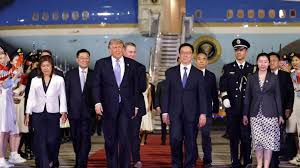
US President Donald Trump arrived in China on Wednesday for a three-day state visit focused on trade, tariffs, regional security, and the ongoing Iran conflict. Invited by Chinese President Xi Jinping, Trump received a ceremonial red-carpet welcome at the airport from Chinese Vice President Han Zheng.
Around 300 Chinese youths waving US and Chinese flags greeted him, while Beijing streets and buildings displayed welcome messages and national flags.
The visit marks Trump’s second trip to China in nine years, following his 2017 visit during his first presidential term.
He is accompanied by senior US business leaders and family members, including his son Eric Trump and daughter-in-law Lara Trump.
Trump’s primary objective is to improve bilateral trade relations and reduce tensions caused by tariffs affecting China’s exports to the United States, valued at over USD 525 billion.
Trump and Xi are expected to hold extensive bilateral talks over two days, including a formal meeting on Thursday and a working lunch and tea session on Friday.
The leaders are meeting face-to-face for the seventh time, having last met in Busan, South Korea, in October 2025.
The White House also indicated that Xi may make a reciprocal visit to the United States later this year.
Ahead of Trump’s arrival, Chinese Vice Premier He Lifeng and US Treasury Secretary Scott Bessent concluded another round of trade negotiations in South Korea.
Discussions reportedly covered tariffs, artificial intelligence, technology cooperation, Taiwan, US arms sales to Taipei, rare earth supplies, and West Asian security issues.
Trade remains a central focus of the visit. Trump stated before leaving Washington that he intended to secure additional Chinese purchases of American agricultural products and aircraft.
Both nations are also considering establishing a bilateral Board of Trade to manage future disputes.
China is expected to benefit economically from the presence of top US corporate leaders accompanying Trump, including Tesla CEO Elon Musk and Apple CEO Tim Cook.
Apple recently regained the top position in China’s smartphone market, while Tesla reported strong growth in China-made vehicle sales.
Despite the strong economic agenda, global attention is focused on whether the summit could help ease tensions in the US-Israel-Iran conflict and reopen the strategically important Strait of Hormuz.
Ahead of the visit, Iranian Foreign Minister Abbas Araghchi travelled to Beijing for talks with Chinese Foreign Minister Wang Yi.
China, a major importer of Iranian oil and a close strategic partner of Tehran, urged Iran to reopen the Strait and maintain its commitment against developing nuclear weapons.
US Secretary of State Marco Rubio commented that China should pressure Iran to avoid further international isolation.
Analysts noted that China seeks stability in West Asia because of its strong economic ties with Gulf nations, including Saudi Arabia, the UAE, and Kuwait.
Taiwan is also expected to be a key issue during the talks. China has repeatedly urged the US to reconsider its support for Taiwan and arms sales to the island, which Beijing claims as part of its territory
Chinese state media stressed that stable US-China relations depend on implementing agreements reached between Trump and Xi during the summit.