


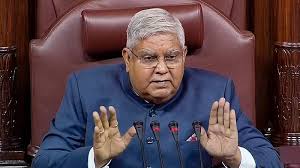
 A political storm has erupted over Vice President Jagdeep Dhankhar’s recent remarks against the judiciary, with the Dravida Munnetra Kazhagam (DMK) strongly condemning his statements as “unethical” and an attack on the principles of constitutional democracy. The Vice President had questioned the Supreme Court’s authority to set timelines for the President and Governors to grant assent to bills passed by State legislatures, drawing sharp criticism from opposition parties and legal experts alike.
DMK Deputy General Secretary and Rajya Sabha MP Tiruchy Siva led the charge against Dhankhar, invoking the doctrine of separation of powers and emphasizing the supremacy of the Constitution. In a strongly-worded post on social media platform X, Siva said, “Under the separation of powers as per the Constitution, the executive, legislative, and judiciary have distinct powers. When all three act in their own spheres, one should not forget that the Constitution is supreme.”
Referring to the Supreme Court’s recent ruling invoking Article 142, which directed that bills passed by a legislature cannot be indefinitely withheld by Governors or the President, Siva stated that the judgment reaffirms constitutional accountability. “The SC verdict has undoubtedly established that no individual, even under the guise of being a constitutional authority, can act against the spirit of the Constitution by delaying assent to bills,” he said. Calling the Vice President’s remarks “unethical,” Siva added, “Every citizen is and must be aware that the rule of law prevails in the Union of India.”
Vice President Dhankhar, speaking at a public event earlier this week, had described the judiciary’s interpretation of Article 142 as overreach and claimed that the apex court was attempting to act like a “super Parliament.” He criticized the SC for “firing a nuclear missile at democratic forces” by prescribing deadlines for constitutional authorities, suggesting that the judiciary had assumed legislative and executive functions without accountability.
“So, we have judges who will legislate, who will perform executive functions, who will act as super Parliament and absolutely have no accountability because the law of the land does not apply to them,” Dhankhar had said, adding that Article 142, which grants wide-ranging powers to the Supreme Court to ensure “complete justice,” had become an unchecked tool.
Dhankhar’s comments have triggered concern among legal scholars and opposition leaders, many of whom argue that the Supreme Court’s order was necessary to address the repeated delays by Governors in giving assent to bills passed by elected legislatures—particularly in non-BJP ruled states. The delay has been seen as a tactic to undermine the legislative will of democratically elected governments.
Legal experts have noted that the SC’s use of Article 142 is within its constitutional mandate, particularly when it comes to ensuring that the executive does not obstruct the functioning of the legislature. The DMK’s strong rebuttal is in line with growing concerns over the perceived encroachment of constitutional roles and the rising tension between institutions of governance.
With elections in the near future and increasing central-state confrontations, the debate around the limits of constitutional authority is only expected to intensify, making institutional integrity and federal balance key issues in the national discourse.