


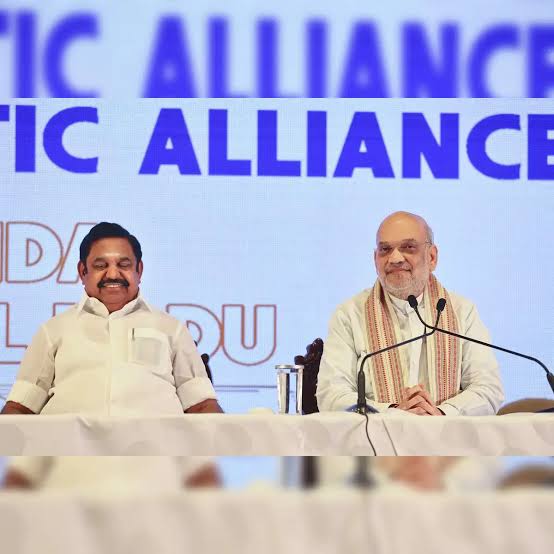
Union Home Minister Amit Shah’s claim that the National Democratic Alliance (NDA) will form a coalition government in Tamil Nadu after the 2026 Assembly elections has triggered political ripples, with AIADMK leaders quickly distancing themselves from the idea.
In an interview with Tamil daily published on Friday, Shah said, “The NDA will form the government in Tamil Nadu after the 2026 Assembly elections and the BJP will be a part of it.” The remark rekindled the ongoing debate over the nature of future political alignments in the state, especially given the historically non-coalition landscape of Tamil Nadu politics.
AIADMK spokesperson and former minister C. Vaigaichelvan firmly pushed back, stating, “So far, people of Tamil Nadu have not accepted coalition governments, and it doesn’t look like they will.” He reiterated that the AIADMK’s only objective was to defeat the ruling DMK, and any clarity on alliance structure would come from party leader Edappadi K. Palaniswami (EPS).
The BJP and AIADMK, after parting ways in 2023 due to differences including remarks by then BJP state chief K. Annamalai, contested the 2024 Lok Sabha elections separately. AIADMK recorded one of its worst performances with a 20.4% vote share, while the BJP, despite fielding candidates in more seats, secured 11.4% — its best yet in Tamil Nadu, though both failed to win any seats.
In April 2025, the two parties realigned, with Shah earlier stating that the NDA—led by AIADMK—would form the next government. While Shah had implied BJP’s participation, EPS and state BJP chief Nainar Nagendran previously clarified that AIADMK would lead, and EPS would be the Chief Ministerial face.
However, Shah’s renewed statement on Friday caused renewed friction. “The Union Home Minister and EPS will discuss this,” Nagendran said, indicating internal conversations were ongoing. Meanwhile, senior BJP leader Pon Radhakrishnan echoed Shah’s view, sharing his statement publicly.
Former AIADMK minister Rajendra Balaji reiterated that AIADMK would lead the alliance and that EPS was the CM candidate. “I don’t know in what context the Union Minister made that statement. But our joint decision is clear,” he said.
This political exchange comes in the backdrop of growing ideological tension between the allies. AIADMK recently condemned attacks on Dravidian stalwarts Periyar and Annadurai during a right-wing Hindu Munnani event backed by the BJP. The party has also taken issue with BJP-linked narratives around the Keeladi archaeological findings.
Shah, in the same interview, defended the Centre’s stance on Keeladi, asserting that any ancient Indian civilisation discovery is a matter of pride, but must meet international scientific standards. He accused Chief Minister M.K. Stalin of diverting attention from corruption and governance issues using emotional topics like Tamil pride and delimitation fears.
While Shah maintained that the NDA’s Chief Ministerial candidate would be from the AIADMK, he stopped short of naming EPS directly, adding to the ambiguity.
As the political climate heats up in the lead-up to the 2026 Assembly polls, the alliance between the BJP and AIADMK remains under strain—balancing regional pride, electoral strategy, and ideological differences.