

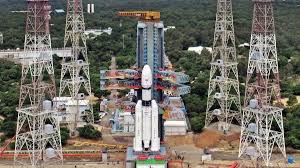
 In a historic milestone for India’s space programme, the Indian Space Research Organisation (ISRO) on Saturday evening successfully launched and injected its heaviest-ever communication satellite, CMS-03 (GSAT-7R), into a precise Geo-synchronous Transfer Orbit (GTO) using the country’s most powerful rocket, LVM3-M5. The achievement marks a new chapter in ISRO’s journey, as it is the first time the space agency has launched a satellite weighing 4,401 kg, making it the heaviest payload ever lifted from Indian soil. After a smooth 24-hour countdown, the 43.5-metre-tall LVM3-M5 rocket, nicknamed “Bahubali” for its immense strength and reliability, thundered off from the Second Launch Pad at Satish Dhawan Space Centre (SHAR) at 5:26 p.m. Following a flight duration of about 1,000 seconds (approximately 19 minutes), the three-stage heavy-lift vehicle precisely injected CMS-03 into the targeted GTO with an inclination of about 24 degrees. The satellite’s initial orbit parameters were an Apogee (farthest point from Earth) of 29,970 km (±3,700 km) and a Perigee (nearest point) of 170 km (±3.5 km). From this orbit, the satellite will use its onboard propulsion system to reach its final position in the geostationary belt at around 36,000 km altitude. The LVM3-M5, weighing 642 tonnes at lift-off, is India’s fifth operational flight of the LVM3 series. With the ability to carry 10 tonnes to Low Earth Orbit (LEO) and around four tonnes to GTO, Saturday’s mission pushed the rocket’s limits, carrying a satellite slightly heavier than its standard GTO capacity, making it a record-setting achievement. ISRO engineers had made several modifications to the vehicle to accommodate the increased payload, marking another example of the organization’s engineering innovation and precision. The CMS-03, also known as GSAT-7R, is a multi-band communication satellite designed to provide secure, high-bandwidth connectivity across the Indian mainland and vast oceanic regions. The satellite will serve both civilian and strategic purposes, playing a pivotal role in strengthening the Indian Navy’s communications network. It replaces the ageing GSAT-7A satellite and joins GSAT-7 and GSAT-7A as part of India’s dedicated military communication fleet. Earlier, the GSAT-7 series catered primarily to defence and maritime operations, while most other communication and earth observation satellites were dual-use, supporting both civilian and military needs. Addressing scientists at the Mission Control Centre moments after the successful launch, ISRO Chairman Dr. V. Narayanan congratulated the entire ISRO team and its industry partners for their “precision, perseverance, and passion.” “I am happy to announce that LVM3-M5 has successfully injected CMS-03 into the precise orbit. This marks the heaviest satellite launch ever from Indian soil,” Dr. Narayanan said, adding that the feat was made possible by numerous technical modifications to the rocket. “All the LVM3 missions so far have been 100 percent successful. This consistency reflects the dedication and hard work of Team ISRO,” he added. The LVM3 (Launch Vehicle Mark-3) has become ISRO’s workhorse for heavy-lift missions. It previously propelled the Chandrayaan-3 mission, which etched India’s name in global space history by making the country the first to land successfully near the lunar south pole. With this successful CMS-03 launch, ISRO has once again proven its capability to undertake complex missions involving heavy payloads, advancing India’s credentials in both space technology and national defence infrastructure. The record-setting launch reaffirms India’s growing stature as a self-reliant space power, capable of deploying advanced satellites to serve strategic, scientific, and societal needs with indigenous technology.
ISRO’s LVM3-M5 successfully launches heaviest satellite
 By NT Bureau
🌐 Translate ▾
- Tamil
- Hindi
- Malayalam
- Kannada
- Telugu
Add A Comment