


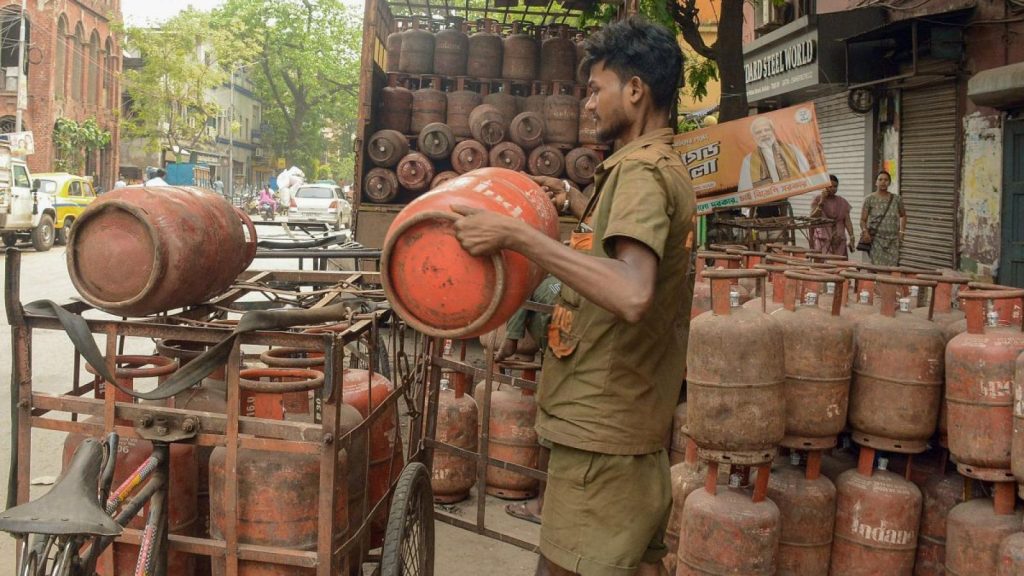
Finance Minister Nirmala Sitharaman on Tuesday said the domestic production of LPG is being ramped up to ensure cooking gas supplies to households, as imports have been disrupted following the closure of the Strait of Hormuz due to the ongoing war in West Asia.
India has sufficient availability of fertilisers for the upcoming Kharif season and will soon begin bidding to import crop nutrients for the winter Rabi crop, the minister stated.
Replying to a debate on the second batch of supplementary demands for grants in the Rajya Sabha, Sitharaman also informed that the government would be clearing oil bonds worth Rs 1.48 lakh crore issued during the UPA government to oil marketing companies in lieu of cash subsidies on petroleum products. The bonds carried interest rates between 7 and 8.4 per cent.
On LPG shortages, Sitharaman said India imports nearly 65 per cent of its requirements.
“The Middle East crisis has come up with a new challenge…Overwhelmingly, 90 per cent of the 65 per cent LPG imports come from the Strait of Hormuz. As a result, there was speculation about whether we would get it or not.
“There are enough reports on how we are ensuring a steady flow during these turbulent times,” she said.
Sitharaman said the Prime Minister’s stress on self-reliance and increasing production to meet the country’s basic demands has helped India.
She said the country has developed its power sector in a big way, which is supporting the needs in many different ways.
The installed power generation capacity has more than doubled since 2014, and there is no energy shortage now, she added.
“Even in the LPG sector, we have been building up capacities and even at this time, the way we have ramped up domestic capacity in LPG is also coming of help,” Sitharaman added.
On March 8, the government directed oil refineries and petrochemical complexes to maximise LPG production by diverting propane, butane, propylene and butane streams to the LPG pool.
“As a result, domestically also, we are ramping up capacities to supply LPG and domestic LPG production is going up about 25 per cent,” she said.
The entire output of this ramped-up capacity is going to domestic consumers.
“So to ensure that households do not suffer, not only steady streams of shipping lines coming in, but domestically we have also ramped up the capacity for production of the LPG diverting from other hydrocarbon material to LPG production.
“As a result, domestic supplies will be adequately streamlined, and supplies will remain steady,” the minister said in the House, which later returned the second batch of supplementary demands for grants to the Lok Sabha with a voice vote.
She further said the ability to ramp up 25 per cent LPG production literally overnight, the availability of alternative energy sources and the reduced share of fossil fuels in the overall energy mix have not happened by accident.
“Steady policy backed up approach by the Government of India has actually resulted in us being able to suddenly improve on something so that any situation, in which any additional support can happen. It is a result of a decade-long energy transition strategy launched by the Prime Minister in 2014,” she said.
Non-fossil electricity stands at 271.97 GW, accounting for more than 52 per cent of the total capacity, and surpassing the fossil fuel capacity of 248.5GW, she informed the House.
For the first time in Indian history, non-fossil capacity exceeded the fossil fuel power generation.
The minister further said the massive hidden borrowing programmes of the UPA government during that period cannot be ignored.