


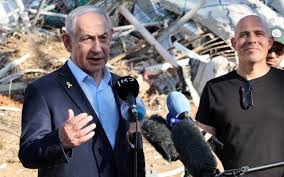
Beirut,Mar 20: Israeli Prime Minister Benjamin Netanyahu has laid out a blunt and aggressive three-point war objective against Iran, signalling a deepening conflict that is rapidly reshaping the balance of power in West Asia. Speaking during a high-stakes press conference, Netanyahu made it clear that Israel is no longer operating in a defensive posture but is actively pursuing what he called the elimination of “existential threats.”
At the core of Israel’s strategy is the dismantling of Iran’s nuclear capabilities. Netanyahu claimed that ongoing military operations have already crippled Tehran’s ability to enrich uranium, though independent verification of this assertion remains unclear. His second objective targets Iran’s ballistic missile programme, which Israel views as an immediate and direct threat to its national security. According to Netanyahu, these threats must be neutralised before they are relocated to fortified underground facilities, making them nearly impossible to destroy through conventional airstrikes.
The third goal is the most politically loaded — creating conditions for internal change within Iran. Netanyahu openly stated that Israel wants to enable the Iranian people to “secure their freedom,” a remark that effectively frames the conflict not just as a military campaign, but as an attempt to destabilise the ruling regime from within. This approach, while strategic on paper, risks escalating tensions far beyond a conventional war, potentially triggering long-term regional instability.
The military campaign, referred to as Operation Rising Lion, has already entered a critical phase. Netanyahu claimed that Iran is being “decimated,” a strong assertion that suggests confidence but also raises questions about overstatement and wartime propaganda. Historically, such claims often serve domestic morale and international positioning rather than reflect ground realities.
Adding another layer to the conflict is the involvement of the United States. Netanyahu praised Donald Trump for what he described as “visionary leadership,” emphasising coordinated action between Washington and Tel Aviv. This alignment significantly raises the stakes, as any prolonged engagement risks drawing in more global powers and widening the conflict.
Meanwhile, Netanyahu dismissed circulating rumours about his death with a direct and almost defiant statement, reinforcing his intent to project control and stability during a volatile period. His messaging throughout the press conference was consistent — assert dominance, project success, and justify escalation.
However, beneath the rhetoric lies a more complex reality. Claims that Iran has lost all capacity to enrich uranium or produce missiles are difficult to accept at face value. Iran has spent decades building redundant and deeply embedded military infrastructure. Completely neutralising such capabilities in a matter of weeks is not just unlikely — it borders on unrealistic.
What is clear, though, is that this conflict is no longer limited to shadow warfare or proxy engagements. It has entered a phase of open confrontation, with both sides signalling that they are prepared for sustained escalation. The consequences of this shift could extend far beyond the region, impacting global energy markets, security alliances, and geopolitical stability in ways that are difficult to predict but impossible to ignore.