


Pugazh Murugan
Chennai, Apr 17:
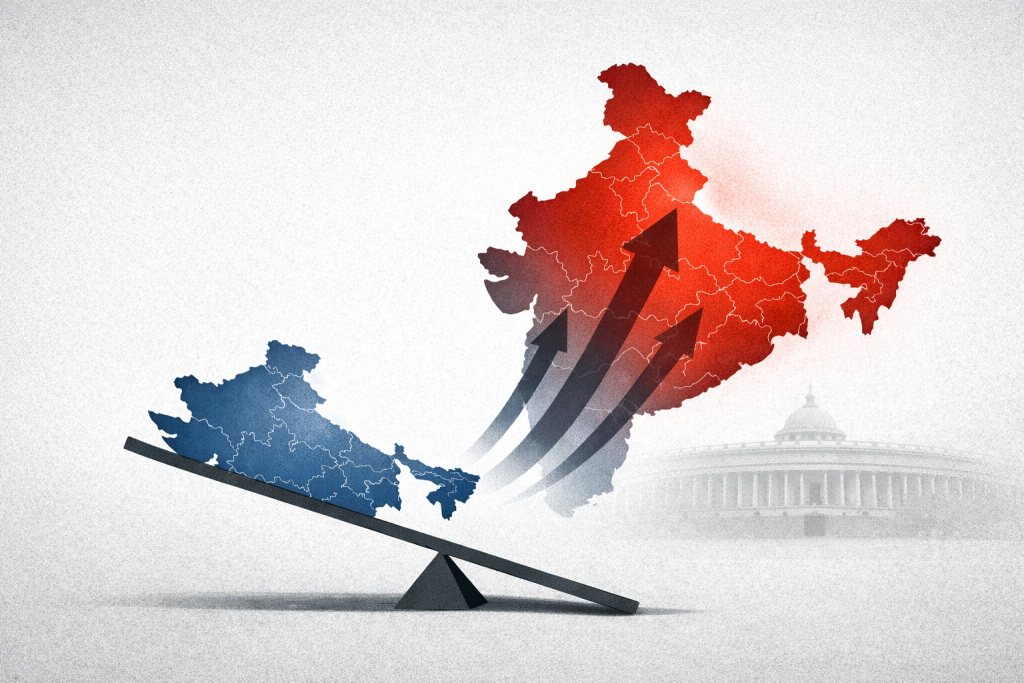
The Union government’s proposal to expand the Lok Sabha and operationalise women’s reservation has reopened a long-standing and sensitive debate in India’s federal structure: how should political representation be balanced across States with sharply different demographic trajectories?
At the centre of the current debate is the decision to link the implementation of 33% reservation for women in Parliament to a fresh delimitation exercise based on the 2011 Census. The government has framed the move as a necessary step to ensure timely reform and to align representation with current population realities. At the same time, several southern States have raised concerns about its long-term implications for political balance within the Union.
The issue goes beyond administrative reform. It reflects a deeper institutional question: how should India reconcile population-based representation with the principles of federal equity?
A structural shift in representation
The Centre’s proposal involves a significant expansion of the Lok Sabha from 543 seats to an estimated 800 or more alongside a nationwide redrawing of constituency boundaries. This delimitation exercise is constitutionally due after the freeze on seat allocation, based on the 1971 Census, ends in 2026.
For decades, this freeze served a dual purpose. It protected States that implemented population control policies from losing representation, while also maintaining stability in the federal balance.
With the freeze set to end, a fresh delimitation is widely seen as necessary to realign representation with demographic changes. However, the transition from a protected framework to a population-based system is also expected to reshape the distribution of seats across States.
Population and proportionality
From the Centre’s perspective, delimitation is grounded in a basic democratic principle: each Member of Parliament should represent a roughly equal number of citizens.
States with higher population growth primarily in northern India are therefore expected to gain a larger share of seats in an expanded Lok Sabha. This is seen as a correction of the current imbalance, where representation does not fully reflect present population figures.
At the same time, States with slower growth, including much of southern India, may see their relative share of seats decline, even as their absolute numbers increase. This distinction between absolute and relative representation lies at the core of the current debate.
The question of policy outcomes
Southern States have framed their concerns in terms of policy outcomes. Since the 1970s, population stabilisation has been a national objective. States such as Tamil Nadu and Kerala achieved this earlier through sustained investments in health, education, and family planning.
The earlier freeze on parliamentary seats was viewed as a recognition of these efforts.With delimitation set to resume, southern leaders have raised the question of whether a purely population-based model adequately accounts for these outcomes. From their perspective, the concern is not about opposing redistribution, but about whether policy success should result in reduced relative influence.
The 2011 Census as a reference point
The use of the 2011 Census introduces another layer to the debate. The Centre has argued that relying on available data allows women’s reservation to be implemented within a clear timeframe, avoiding further delays.
However, critics point out that demographic changes over the past decade including migration and urbanisation may not be fully reflected in older data. This creates a tension between administrative feasibility and representational accuracy.
Women’s reservation & institutional sequencing
The linkage between delimitation and women’s reservation reflects an attempt to implement two structural reforms together.
The Constitution (106th Amendment) Act, 2023, made the 33% quota contingent on a fresh census and delimitation exercise. The current proposal seeks to operationalise this provision using existing data, enabling implementation from the 2029 general election.
While the objective of increasing women’s representation has broad support, the sequencing of reforms has added complexity to the policy process. Balancing democratic equality and federal structure.
The debate ultimately centers on competing but legitimate principles. According to PRS Legislative Research, delimitation involves inherent trade-offs.
“Delimitation based purely on population will inevitably shift the balance of representation toward States with higher population growth. The question is whether and how other factors should be incorporated to address federal concerns,” a PRS analysis note observed.
This reflects the central tension:
- Population-based equality supports democratic fairness
- Federal balance seeks to ensure equitable influence across States
Both principles carry institutional weight.
Administrative and institutional questions
- Several operational issues remain to be clarified:
- Criteria for identifying constituencies reserved for women
- Mechanism for rotation of reserved seats
- Interaction with existing SC/ST quotas
- Transparency of the delimitation process
While the exercise is conducted by an independent commission, its long-term political implications make these questions significant.
Voices from the ground
Public opinion reflects both support for reform and concern about its outcomes.
“We are not against increasing seats or women’s representation. But if States that controlled population growth lose relative voice, it raises a fairness issue,” said Priya Narayanan, a school teacher in Chennai.
Such views capture the broader nature of the debate, less about opposition and more about the terms of implementation.
Looking ahead
The proposed legislation requires a two-thirds majority in Parliament. If passed, a delimitation commission will be constituted, and new constituency boundaries are expected to take effect from the 2029 general election. Given the scale of the reform, the process is likely to remain politically and institutionally significant.
The delimitation exercise represents a pivotal moment in India’s democratic evolution. For the Centre, it is an opportunity to align representation with current population realities and implement long-pending reforms. For Southern states, it raises questions about how federal balance and past policy outcomes are reflected in that process. The challenge lies not in choosing between these perspectives but in reconciling them within a framework that is both democratically sound and institutionally equitable.
How this balance is achieved will shape the future of representation in India.