


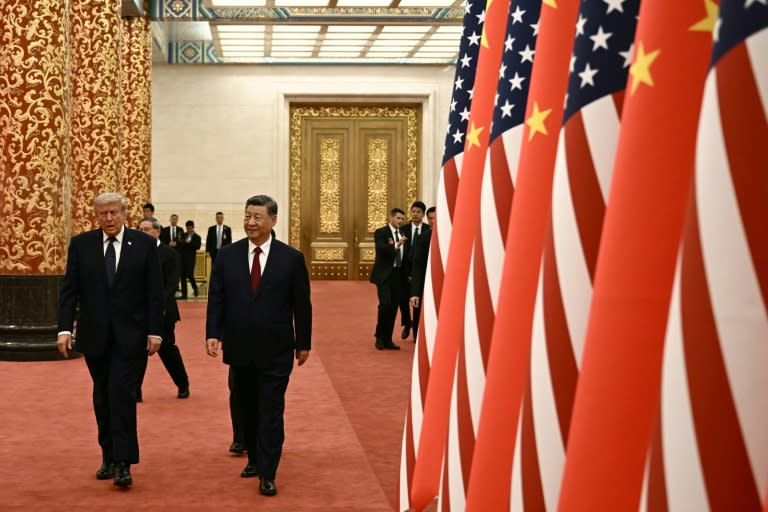
Beijing, May 16:
XiJinping and Donald Trump concluded what both sides described as highly successful and historic talks at the end of Trump’s three-day visit to China, though no concrete agreements were announced on major contentious issues.
The visit marked the first by a US president to China in nine years, with Trump himself being the last American leader to visit Beijing in 2017.
The two leaders held multiple rounds of discussions covering global and bilateral concerns, including the Iran conflict, trade tensions, energy security, Taiwan, semiconductor exports, and rare-earth minerals.
Their final meeting took place at Zhongnanhai, the heavily guarded leadership compound in Beijing, where the two presidents were seen walking through gardens and holding private conversations.
According to the Chinese account, Trump described the visit as “very successful, world-renowned, and unforgettable.” Referring to Xi as “an old friend,” Trump expressed deep respect for the Chinese leader and said he hoped to continue sincere and direct communication.
He also invited Xi to visit the White House later this year. Xi called the visit “historic” and “landmark,” saying both countries had established a “new vision” for a constructive and stable China-US relationship.
He stated that the two sides had reached important common understandings on maintaining stable economic and trade relations, expanding practical cooperation, and handling each other’s concerns appropriately.
Xi added that China and the US also agreed to strengthen communication and coordination on regional and international matters.
The Chinese president stressed that stronger cooperation between the world’s two largest economies would help both countries achieve their national goals.
While Trump aimed to “make America great again,” Xi said he was focused on China’s national rejuvenation. He urged both sides to preserve the positive momentum generated during the visit and avoid actions that could damage relations.
Despite the optimistic tone, neither side announced specific deals on sensitive issues. Chinese Foreign Ministry spokesperson Guo Jiakun avoided providing details about any understandings reached on matters such as the Iran conflict, Chinese purchases of US oil, rare-earth exports, or semiconductor restrictions.
China recently limited exports of rare-earth minerals, which are essential for products ranging from smartphones to aircraft, in response to US tariffs on Chinese goods.
When asked whether Beijing had agreed to resume supplies or whether Washington would ease restrictions on semiconductor exports to China, Guo reiterated China’s standard positions without confirming any agreements.
Taiwan also remained a major issue during the talks. During Thursday’s meeting, Xi reportedly warned Trump that mishandling the Taiwan issue could lead to “clashes and even conflicts” between the two nations.
According to the White House, both leaders agreed on the importance of keeping the Strait of Hormuz open to ensure global energy flows.
Trump also formally invited Xi and his wife to Washington on September 24. Although no breakthrough deals emerged, both governments portrayed the summit as a step toward stabilising and improving China-US relations amid ongoing geopolitical and economic tensions.