


Chennai, June 22:
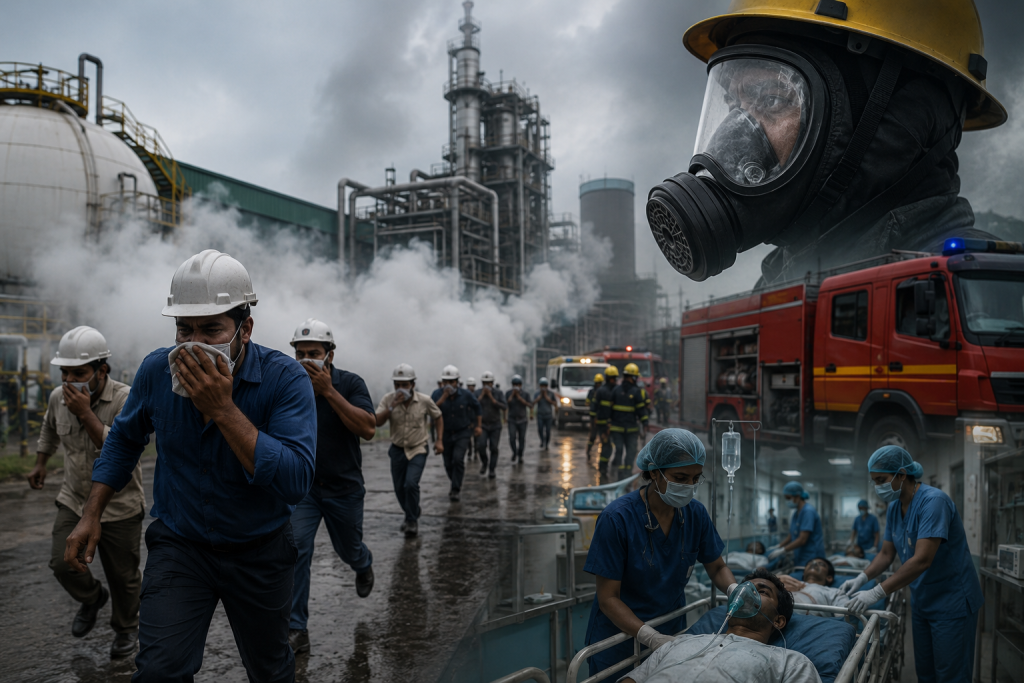
The recent ammonia gas leak at a shrimp processing unit in Kannigaipair near Periyapalayam in Tiruvallur district, which claimed five lives and left 67 workers under treatment across hospitals, has once again brought industrial safety in Tamil Nadu under sharp scrutiny.
According to the Health and Family Welfare Department bulletin, 74 workers were affected when ammonia gas leaked at the facility on Sunday. While two deaths were reported initially, three more workers succumbed overnight. Victims experienced severe respiratory distress, including breathlessness, eye and throat irritation, coughing, and chest discomfort, with several patients requiring ventilator support.
Medical teams across Vels Medical College Hospital, Venkateshwara Medical College Hospital, Government Stanley Medical College Hospital, and Rajiv Gandhi Government General Hospital continue to monitor critically ill patients.
Emergency services including fire and rescue teams, police personnel, and public health officials were quickly deployed, but the scale of exposure highlights how rapidly industrial gas leaks can turn fatal.
A Pattern of Industrial Disasters
Tamil Nadu, one of India’s most industrially advanced states, has repeatedly witnessed chemical leaks, factory fires, and hazardous material exposure incidents over the years. Experts say that while industrial growth has created employment and economic expansion, safety enforcement has not always kept pace with operational risks.
Industrial safety analysts point to recurring issues such as inadequate maintenance of storage systems, weak leak-detection infrastructure, poor emergency preparedness, and insufficient worker training in handling hazardous substances.
A senior public health expert, speaking on condition of anonymity, said: “Most industrial accidents are not sudden failures. They are the result of small safety lapses accumulating over time. Gas leaks in particular become deadly within minutes if detection and evacuation systems are not robust.”
Why Gas Leaks Are Especially Dangerous
Ammonia and similar industrial gases can cause rapid respiratory failure when inhaled in high concentrations. Unlike visible hazards such as fire, gas leaks are often invisible and odor-detectable only at dangerous levels.
Doctors say early symptoms like eye irritation or mild breathlessness are often underestimated, delaying evacuation. A pulmonologist noted: “By the time severe respiratory distress sets in, exposure has already reached critical levels. Immediate evacuation is the only lifesaving measure in such cases.”
Key Prevention Measures
Experts emphasize that preventing such disasters requires a combination of technology, regulation, and training: Stronger Safety Audits Regular, unannounced inspections of factories handling hazardous chemicals must be mandatory, with strict penalties for non-compliance.
Real-Time Gas Detection: Systems Facilities should install automated sensors that trigger alarms and shutdown systems immediately upon detecting leaks.
Worker Training and Drills: Employees must be trained to recognize early warning signs and conduct evacuation drills regularly.
Emergency Response Infrastructure: Quick access to oxygen support, protective gear, and emergency medical transport can significantly reduce fatalities.
Strict Licensing and Accountability: Industries handling toxic substances must undergo periodic license renewal based on safety compliance records.
A senior environmental safety consultant explained: “Technology alone is not enough. What we need is a culture of safety where every level of management treats prevention as seriously as production targets.”
Balancing Growth and Safety
Tamil Nadu’s industrial sector continues to expand, especially in manufacturing, textiles, food processing, and chemicals. However, experts warn that economic growth without safety enforcement can lead to recurring human tragedies.
A labor rights advocate said: “Workers are the first to suffer and the last to be heard. Safety cannot be treated as optional compliance—it must be central to industrial planning.”
A Preventable Loss
As families mourn the victims of the Tiruvallur ammonia leak, the incident stands as yet another reminder that most industrial disasters are preventable.
The challenge ahead lies not only in responding to emergencies, but in building systems strong enough to ensure such emergencies never occur in the first place.