


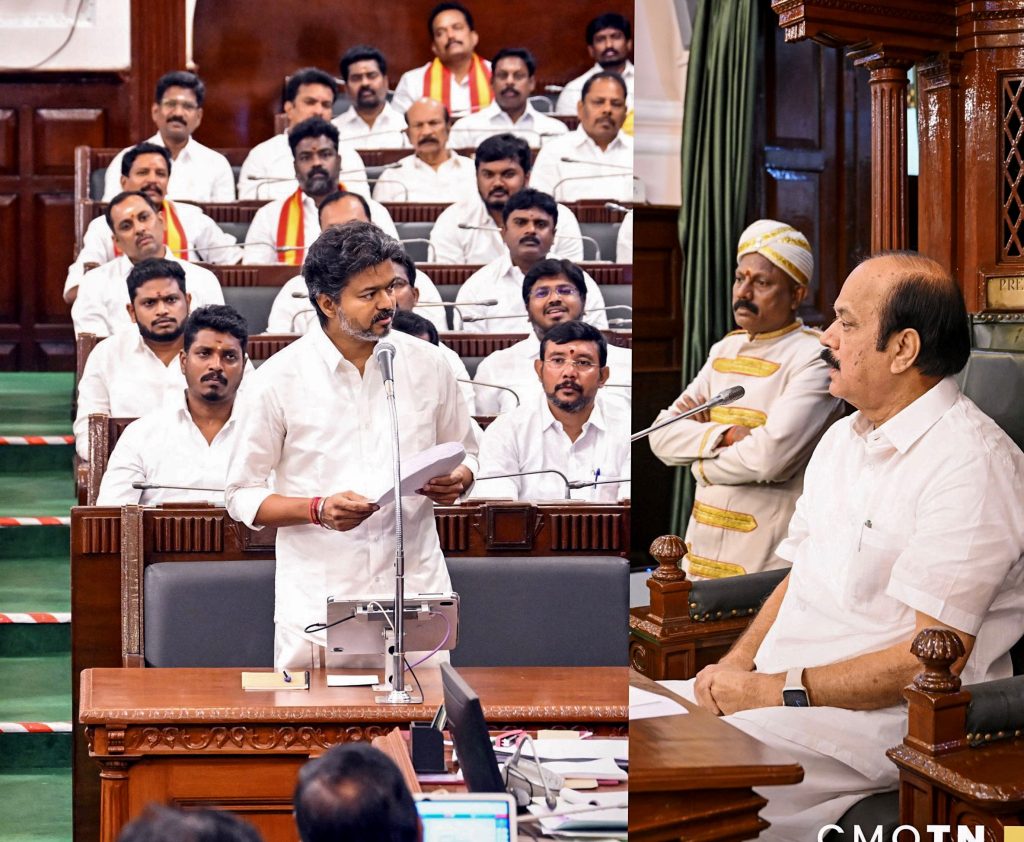
Chennai, Aug 11:
The Tamil Nadu Legislative Assembly on Tuesday passed a resolution urging the Union government to abolish the National Eligibility-cum-Entrance Test (NEET) for undergraduate medical admissions, with the ruling TVK government arguing that the centralised examination places rural, poor, Tamil-medium and socially disadvantaged students at a disadvantage.
The resolution, moved by Health Minister KG Arunraj, called upon the Centre to amend the relevant laws and withdraw the uniform NEET system for admission to undergraduate medical courses. The resolution was supported by the ruling TVK and its allies as well as the principal Opposition parties, including the DMK and AIADMK. The BJP member in the House opposed the resolution and staged a walkout.
Participating in the debate, Arunraj said the State had consistently opposed NEET on the grounds of social justice, equality and the rights of States to frame policies suited to their educational and healthcare requirements.
He said the examination had shifted the focus of students from their regular school curriculum towards intensive coaching and had resulted in the mushrooming of private coaching centres charging high fees.
According to the resolution, students from rural areas, economically weaker families and Tamil-medium backgrounds face greater difficulties in preparing for a highly competitive national-level examination. It argued that students who cannot afford expensive coaching are placed at a disadvantage compared with those who have access to private training for several years.
The State government said NEET had effectively made performance in a single entrance examination a decisive factor in determining the medical education prospects of students after 12 years of schooling.
The resolution expressed concern that large numbers of students were compelled to spend their higher secondary years preparing specifically for NEET rather than concentrating on the broader school curriculum.
It also highlighted the growing dependence on coaching centres and alleged that the high cost of such coaching had widened the gap between students from affluent families and those from economically weaker backgrounds.
The government maintained that a medical admission system should provide equal opportunities to students irrespective of their economic background, place of residence or medium of instruction.
The resolution also referred to the Tamil Nadu Assembly’s earlier efforts to obtain exemption from NEET.
It recalled that the Assembly had unanimously passed a Bill in 2021 seeking exemption for Tamil Nadu from NEET for undergraduate medical admissions. The State government said the Bill had not received presidential assent and that the issue continued to remain unresolved.
The Vijay government has now reiterated the State’s demand for an alternative admission mechanism, proposing that medical admissions in Tamil Nadu be based primarily on Class 12 examination marks, subject to the applicable legal framework.
The government argued that such a system would give greater importance to sustained academic performance throughout the higher secondary years rather than placing disproportionate weight on a single entrance examination.
The resolution also cited irregularities and question-paper leak controversies surrounding competitive examinations as reasons for reconsidering the existing system.
It said incidents involving examination irregularities had undermined the confidence of students and parents in the testing process and caused considerable anxiety among candidates who had invested years preparing for medical admission.
The State also pointed to the intense psychological pressure associated with NEET preparation and the examination process, including cases of students facing severe distress after failing to secure the marks required for medical admission.
Tamil Nadu has for several years maintained that the examination’s structure and the coaching ecosystem surrounding it disproportionately affect students who lack financial resources.
Apart from the question of social justice, the State government has also raised the issue of federalism.
Tamil Nadu has argued that education and healthcare are closely connected to the requirements of individual States and that States should have greater flexibility in determining admission policies for medical education, particularly when they are responsible for creating and maintaining a large part of the public healthcare system.
The resolution therefore urged the Centre to amend the National Medical Commission Act, 2019, and other relevant central legislation to enable the discontinuation of NEET for undergraduate medical admissions.
The government said a decentralised approach would allow States to design admission policies based on their educational environment, social composition and healthcare requirements.
The anti-NEET resolution assumed significance as it received support from across the political spectrum in the Assembly.
The DMK, which had been in government before the 2026 elections, has also consistently opposed NEET and demanded an exemption for Tamil Nadu. The AIADMK too supported the resolution, ensuring broad political backing for the State’s demand.
The BJP, however, has maintained its position in favour of the national-level entrance examination, arguing that a common examination provides a uniform and transparent mechanism for medical admissions across the country.
The Assembly’s resolution is not, by itself, sufficient to abolish NEET. Since the examination is governed by central legislation and regulations, the demand will require action by the Union government and amendments to the relevant laws.