


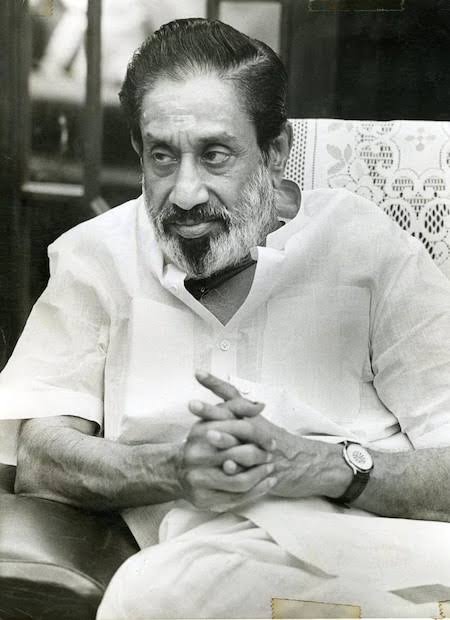
There are actors who play characters, actors who immerse themselves in characters and then there is Sivaji Ganesan, who seemed to make every character live and breathe on screen. On his birth anniversary today, October 1, Tamil cinema celebrates the enduring legacy of an actor whose voice, eyes, body language, expressions and extraordinary command over dialogue turned acting into an art form of its own.
Born Villupuram Chinnaiya Manrayar Ganesamoorthy on October 1, 1928, Sivaji Ganesan entered the world of theatre at a very young age. Years of stage experience gave him an extraordinary command over dialogue delivery, voice modulation, expressions and physical movement. When he entered cinema with Parasakthi in 1952, he brought with him a theatrical discipline that was soon transformed into a distinctly cinematic style.
What set Sivaji apart was his ability to completely surrender himself to a character. He did not simply wear a costume and deliver lines. He changed his voice, gait, posture, mannerisms and even the way he occupied space according to the character he played. A king did not walk like a commoner, a lawyer did not sit like a musician and a proud patriarch did not carry himself like a vulnerable old man. Every detail had a purpose.
His voice was perhaps his most recognisable instrument. Sivaji could make it thunder with authority, tremble with emotion, sparkle with humour or sink into a whisper. His dialogue delivery had rhythm, precision and emotional force. Yet his greatest strength was that he knew when not to speak. A pause, a look or a slight change in expression could sometimes convey what an entire paragraph of dialogue could not.
His eyes were equally expressive. In films such as Pasamalar, Deiva Magan and Muthal Mariyathai, Sivaji demonstrated that powerful acting did not always require words. A fleeting glance could reveal affection, anger, humiliation, helplessness or longing. His face became a canvas on which the emotional history of a character was painted.
His range was extraordinary. He played kings and warriors, lawyers and patriarchs, musicians and villagers, lovers and villains, comic characters and tragic figures. In Navarathiri, he famously appeared in nine different roles, demonstrating his ability to create distinct personalities without allowing one character to spill into another.
His portrayal of Veerapandiya Kattabomman remains one of the most celebrated performances in Indian cinema. The booming voice, proud bearing and defiant body language transformed the historical figure into a cinematic icon. For generations, Sivaji’s Kattabomman became the reference point for grandeur, patriotism and commanding screen presence.
Yet the true measure of his greatness was not his ability to perform larger-than-life characters. It was his ability to come down from that pedestal and become an ordinary human being. In Vietnam Veedu, he portrayed the pride, anxieties and emotional wounds of a middle-class patriarch. In Muthal Mariyathai, he discarded much of the theatrical flamboyance associated with his earlier performances and delivered a restrained, deeply moving portrayal of a lonely village elder.
That ability to adapt was the secret of his longevity. Sivaji never had just one style of acting. He had several. He could be majestic in one film, vulnerable in another, humorous in the next and almost completely restrained in yet another. His performances demonstrated that acting was not about repeating a successful formula but discovering what each character demanded.
Thillana Mohanambal is another example of his remarkable understanding of character. As nadaswaram artiste Sikkal Shanmugasundaram, Sivaji did not merely play a musician. His pride, temperament, mannerisms, artistic ego and emotional vulnerability were woven into every movement. The performance remains memorable because the character appears to exist independently of the actor.
Perhaps the most remarkable aspect of Sivaji’s career was his ability to make audiences forget the actor and see only the character. When he appeared as a king, audiences saw a king. When he appeared as a father, they saw a father. When he portrayed a wounded old man, they felt his loneliness. That is the ultimate test of an actor — disappearing into the role while remaining completely in command of the performance.
His influence extended far beyond Tamil cinema. Generations of actors have acknowledged his contribution, while his performances continue to be studied, admired and imitated. His international recognition included the Best Actor award at the Afro-Asian Film Festival in Cairo in 1960. He later received the Dadasaheb Phalke Award and was honoured as a Chevalier of the Ordre des Arts et des Lettres in France. The Padma Shri and Padma Bhushan were among the other major honours he received.
But Sivaji Ganesan’s real legacy cannot be measured by the number of awards on a shelf. It lives in the way actors continue to study his dialogue delivery, his expressions, his pauses and his physical transformation. It lives in the dialogues that generations have memorised. It lives in the scenes that continue to be replayed. And it lives in the instinctive reaction of audiences who still recognise a particularly powerful performance by saying, “That is Sivaji.”
Cinema has changed enormously since Sivaji Ganesan’s debut. Acting styles have evolved, technology has transformed filmmaking and audiences have developed new expectations. Yet his best performances remain remarkably alive because they are rooted in something technology cannot manufacture — observation, preparation, emotional understanding and sheer acting ability.
That is why Sivaji Ganesan is remembered as Nadigar Thilagam. The title is not merely a tribute to a superstar of another era. It reflects the extraordinary breadth of an actor who could roar like a warrior, command like a king, laugh like a comedian, suffer like a common man and break a heart with a single look.
There have been countless talented actors before and after him. Many have created memorable characters and many have achieved legendary status. But Sivaji Ganesan occupies a special place in the history of Indian cinema because he turned acting into an institution.
On his birth anniversary, the most fitting tribute to the legendary actor is perhaps a simple one: many actors have mastered the craft of acting, but Sivaji Ganesan made the craft itself look limitless.