


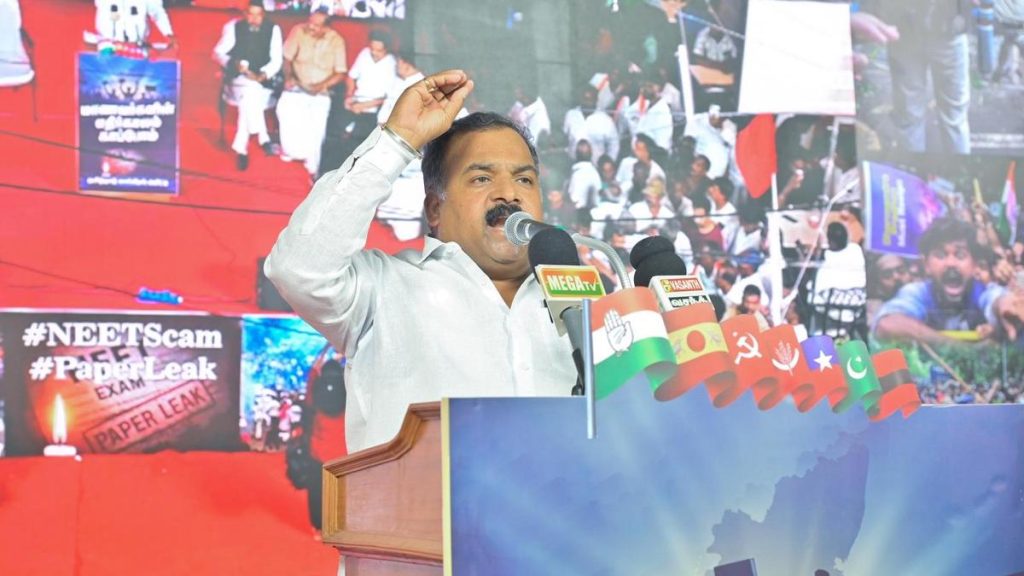
Chennai, Oct 13:
Congress leader and Tamil Nadu Congress Committee president B Manickam Tagore has blamed corruption, deteriorating law and order, controversial remarks against women and the DMK’s treatment of its alliance partners for the party’s defeat in the 2026 Assembly election. Rejecting the argument that the Special Intensive Revision (SIR) of electoral rolls contributed significantly to the DMK’s electoral setback, he said the party should examine its own political failures instead of attributing the defeat to the voter-list revision exercise.
Tagore questioned the DMK’s current criticism of the SIR process, pointing out that the party had earlier maintained that the exercise had been completed successfully without major problems. He argued that the DMK’s position after the election was inconsistent with its earlier assessment of the revision process.
He also referred to alleged irregularities associated with the SIR exercise in West Bengal, Assam, Bihar, Maharashtra and Haryana. According to Tagore, Tamil Nadu, Kerala and Puducherry had not reported similar complaints. His remarks placed the focus on the Congress leader’s assessment that the DMK’s electoral setback should be understood primarily in terms of governance, public perception and political strategy.
Tagore further criticised the DMK for not participating in the protest in Delhi demanding the resignation of the Chief Election Commissioner. Leaders from Left parties, the Viduthalai Chiruthaigal Katchi (VCK) and the Marumalarchi Dravida Munnetra Kazhagam (MDMK) from Tamil Nadu had taken part in the agitation and were arrested, he said.
Alleging that the DMK had stayed away from the protest because it was reluctant to antagonise the BJP, Tagore questioned whether the party was prepared to take a firm stand on issues involving democracy and secularism. He said the DMK should have joined the agitation if it was genuinely concerned about Tamil Nadu’s interests and the protection of democratic institutions.
The remarks highlight differences within the broader opposition camp over the interpretation of the election results and the response to the voter-roll revision exercise. Tagore’s comments also underline the Congress leadership’s criticism of the DMK’s handling of its allies and its political positioning. His assessment, however, represents the Congress leader’s view of the defeat, rather than an independently established explanation of all the factors that shaped the electoral outcome.