


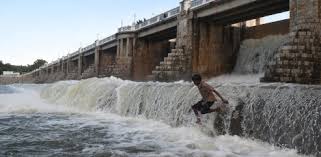
 In a significant development for Chennai’s water supply, Krishna water from Andhra Pradesh’s Kandaleru Dam reached Tamil Nadu’s Poondi reservoir on Monday night. This marks a crucial moment for the city, as Poondi reservoir is a major source of drinking water, currently struggling with declining levels due to the summer heat.
The inflow of water comes after Tamil Nadu’s Water Resources Department requested the release of water from the Kandaleru Dam to address the acute shortage faced by Chennai. Initially, water was released on September 19 at a rate of 500 cubic feet per second (cusecs), which was later increased to 1300 cusecs, allowing a larger volume of water to flow towards Tamil Nadu.
The journey of the Krishna water spanned a total of 177 kilometers, starting from Kandaleru Dam and traveling 152 kilometers to Thamarai Kuppam Zero Point near Uthukottai, where it arrived on Monday morning. The arrival was celebrated by officials with a traditional shower of flower petals, marking the importance of this water source. By 7 PM the same day, the water had traveled an additional 25 kilometers to reach the Poondi reservoir, arriving with an inflow rate of 50 cusecs.
The release of water was not without challenges. Earlier requests by Tamil Nadu were denied due to low levels in the Kandaleru Dam, highlighting the difficulties in managing interstate water resources. However, recent heavy rains in Andhra Pradesh improved the storage levels in the Kandaleru Dam, allowing water to be released to Poondi Lake.
The arrival of Krishna water is a crucial step in alleviating the ongoing water shortage in Chennai. The Poondi reservoir, one of the key sources of drinking water for the city, had been under stress due to insufficient inflows and high consumption rates. The additional water supply from Andhra Pradesh is expected to provide much-needed relief, ensuring a stable water supply for Chennai’s residents in the coming days.
This water release not only underscores the importance of inter-state water cooperation but also highlights the ongoing need for effective water management strategies to combat the challenges posed by seasonal variations and rising demand.