


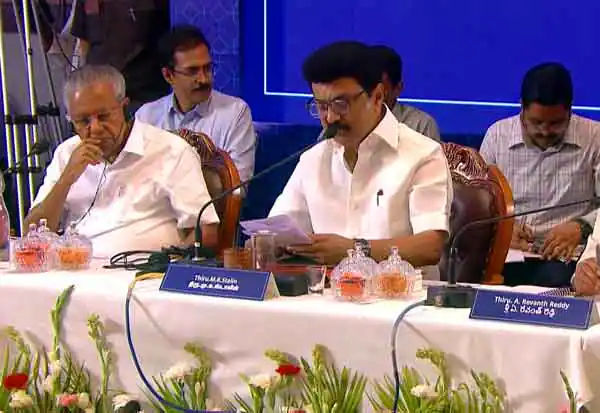

Tamil Nadu Chief Minister M.K. Stalin strongly opposed the idea of constituency delimitation based solely on population, stating that the issue is not just about numbers but about power and representation. Speaking at the joint action committee meeting in Chennai’s Guindy, he emphasized that India’s federal structure must be protected.
The high-profile meeting, convened to discuss the concerns of southern states regarding the proposed delimitation exercise, saw the participation of several key political leaders. Among them were Punjab Chief Minister Bhagwant Mann, Kerala Chief Minister Pinarayi Vijayan, Telangana Chief Minister A. Revanth Reddy, and Karnataka Deputy Chief Minister D.K. Shivakumar.
In his opening remarks, Stalin welcomed all attendees and stressed the need for unity in safeguarding democracy. He pointed out that India is a diverse nation with multiple languages, cultures, and ethnicities, and that any delimitation exercise that disproportionately affects certain states—particularly those in the south—would be fundamentally unfair.
“We are gathered here today not just as political representatives but as defenders of democracy and federalism. This is a historic moment in our nation’s journey, and we must stand together to ensure that the essence of cooperative federalism is not eroded,” Stalin declared.
The Chief Minister made it clear that Tamil Nadu and other southern states firmly oppose any delimitation exercise that is purely based on population figures. He argued that such a move would weaken the political voice of states that have successfully implemented population control measures.
“If representation is determined solely by population, then states that have taken effective steps in controlling birth rates will be punished, while those that failed to do so will be rewarded. This is not about numbers—it is about power and equitable representation. Accepting this proposal would mean that many of us will be reduced to having no real authority in our own country,” he said.
As an alternative, Stalin proposed forming an expert committee to study the impact of delimitation and suggest a fair and balanced approach. He clarified that the opposition was not against delimitation itself but against an unfair and arbitrary process that could weaken the political influence of the southern states.
“This is not a protest against the idea of redrawing constituencies. This is a demand for a just and reasonable approach. The expert committee should ensure that any changes in representation do not undermine the federal structure of the country,” he added.
Stalin also criticized Union Home Minister Amit Shah’s recent remarks on the issue, stating that they lacked clarity and created confusion. He accused the BJP of being a party that consistently undermines the rights of states.
“The explanation given by Amit Shah in Coimbatore was unclear and misleading. The BJP has always functioned as a party that weakens state rights. We cannot allow them to dictate terms that will disadvantage states like Tamil Nadu,” Stalin said.
One of the major concerns raised in the meeting was the potential loss of parliamentary constituencies in Tamil Nadu and other southern states. Stalin warned that Tamil Nadu could lose 8 to 12 Lok Sabha seats, while the entire southern region could lose as many as 100 seats.
“A reduction in constituencies means a reduction in financial allocations and developmental resources. Our unique cultural and social identity is at risk. Social justice will suffer if our representation in Parliament is unfairly reduced,” he warned.
Another major argument against the proposed delimitation was that it would diminish the political influence of southern states in national policymaking. Stalin emphasized that representation in Parliament is not just about numbers—it is about having a voice in governance.
“If our number of MPs decreases, our ability to influence national policy weakens. We will have fewer representatives to fight for our rights, raise our concerns, and advocate for the needs of our people. This is unacceptable,” he asserted.
The meeting was attended by representatives from 23 political parties across eight states, including the DMK and its alliance partners, Biju Janata Dal (BJD), Aam Aadmi Party (AAP), Jana Sena Party, Bharat Rashtra Samithi (BRS), and several Kerala-based parties. Notably, West Bengal Chief Minister Mamata Banerjee’s Trinamool Congress (TMC) chose to skip the meeting.
In conclusion, Stalin called for a united front to resist any attempts to weaken the representation of states that have been instrumental in India’s progress. He urged all political parties, regardless of ideological differences, to come together in defense of democratic principles and federalism.
“We must fight together to protect our rightful representation. No matter the circumstances, we cannot afford to let our voices be silenced. Only through collective action can we safeguard the future of our states and our country,” he declared.