


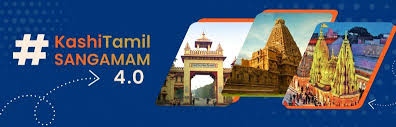
 The fourth edition of the Kashi Tamil Sangamam, celebrating the timeless civilisational connection between Tamil Nadu and Kashi (Varanasi), opened on Tuesday with a strong message of national integration, cultural exchange, and linguistic harmony. The 16-day event, themed “Let Us Learn Tamil”, will run from December 2 to 17 and aims to strengthen bonds between two of India’s most enduring cultural landscapes.
In a special video address, Vice-President C.P. Radhakrishnan described the Sangamam as a major national platform since its inception in 2022 during the Azadi Ka Amrit Mahotsav. He underlined the shared heritage of the Ganga and Cauvery civilisations, calling Kashi and Tamil Nadu the twin radiant lamps of Bharat’s ancient legacy. Referring to Prime Minister Narendra Modi’s recent Mann Ki Baat, he noted that the event symbolises the meeting of one of the world’s oldest living cities with one of the world’s most ancient classical languages.
A key highlight of this year’s edition is the participation of 50 Hindi-speaking teachers, trained by the Central Institute of Classical Tamil, who will teach Tamil to more than 1,500 students in Varanasi. The symbolic Agathiyar Yatra from Tenkasi to Kashi and the planned visit of 300 Uttar Pradesh students to premier institutions in Tamil Nadu further reflect the programme’s commitment to cultural and academic exchange.
Prime Minister Narendra Modi extended his greetings to participants, calling the Sangamam a vibrant initiative that deepens the spirit of “Ek Bharat, Shreshtha Bharat.” He expressed hope that all visitors would have a meaningful and memorable stay in the sacred city of Kashi.
At the inauguration at Namo Ghat, Uttar Pradesh Chief Minister Yogi Adityanath welcomed the delegates with chants of “Vanakkam Kashi” and “Har Har Mahadev.” He said the event was inspired by the Prime Minister’s vision and reaffirmed that Lord Shiva forms the spiritual bridge between Kashi and Tamil Nadu, a bond historically strengthened by Adi Shankaracharya. He also flagged off the ‘Then Kashi to Kashi’ 2,000-km car rally, adding symbolic depth to the celebration.
Union Education Minister Dharmendra Pradhan used the occasion to criticise what he called politically motivated attempts to create division through language in Tamil Nadu. Stressing that India’s strength lies in its multilingual fabric, he said all Indian languages must be learned and celebrated. He reiterated his annual invitation to Chief Minister M.K. Stalin to attend the Sangamam and witness the deep-rooted cultural connection between the regions.
Union Minister L. Murugan, sharing a personal reflection, said political circumstances in Tamil Nadu had prevented him from learning Hindi earlier. “Whatever Hindi I learned, I learned after coming to Delhi,” he said, adding that learning any language is a fundamental right and should never be restricted.
For young scholars and delegates, the Sangamam represents much more than a cultural event. Selvamuthumaari, a PhD scholar from Pondicherry University, called it “a gift for future generations,” emphasising that it enables people to understand and appreciate each other’s language and heritage.
During the ceremony, Dharmendra Pradhan also unveiled Tholkappiyam, the ancient Tamil grammatical text, translated into 10 other languages including Odia and Spanish, reinforcing the global relevance of Tamil literature.
Several dignitaries including Tamil Nadu Governor R.N. Ravi, Puducherry Lieutenant Governor K. Kailashnathan, IIT–Madras Director V. Kamakoti, CICT Director R. Chandrasekaran, and others were present to witness the historic moment.
The Kashi Tamil Sangamam 4.0 thus stands as a powerful reminder of India’s shared cultural roots—where language does not divide, but unites, and where tradition and unity meet on the ghats of Kashi.