


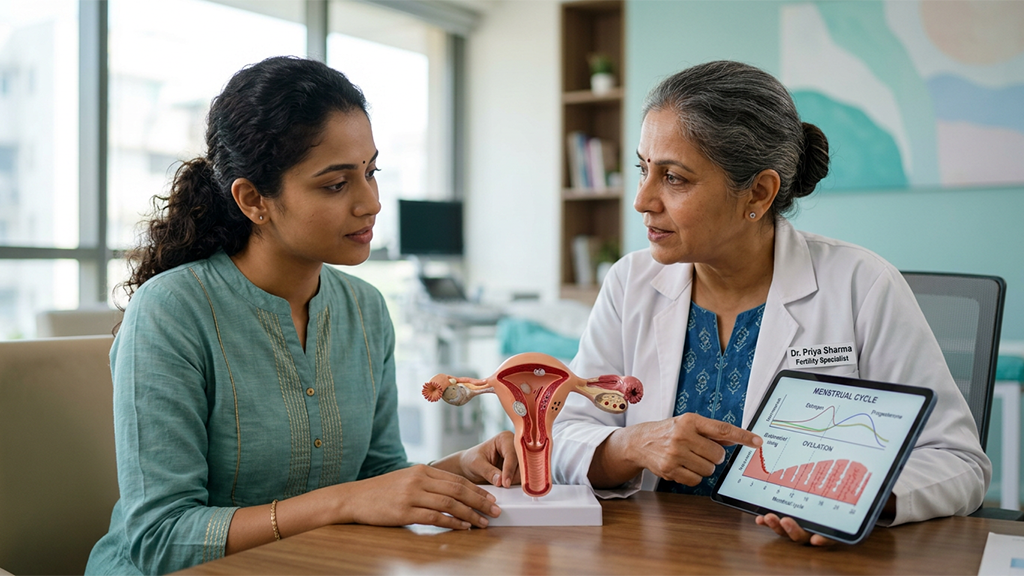
Many women notice changes in their period long before they think about fertility. A period that once lasted five days may become two days. Bleeding may feel lighter than usual, or there may be only spotting. It is natural to wonder, “Is my body producing fewer eggs?” or “Will I find it difficult to get pregnant?”
The honest answer is: a light period flow does not automatically mean low fertility. Some women naturally have lighter bleeding and conceive without difficulty. But when light flow is new, persistent, or comes with irregular cycles, pain, missed periods, acne, weight changes, or difficulty conceiving, it deserves medical attention.
At ARC Fertility Hospitals, doctors look beyond the amount of bleeding. They evaluate ovulation, hormones, ovarian reserve, uterine lining, fallopian tubes, and the male partner’s semen health. Fertility is rarely explained by one symptom alone.
What Is Considered a Light Period?
A light period usually means bleeding that is much less than your usual pattern. It may last only one or two days, require very few pads, appear mostly as spotting, or be pale pink or brown instead of a regular red flow. The important comparison is not with another woman’s period, but with your own previous cycles.
If your periods have always been light, regular, and predictable, it may simply be your normal pattern. But if your flow has suddenly reduced over a few months, especially while trying for pregnancy, it is wise to get evaluated.
How Period Flow Is Connected to Fertility
Menstrual bleeding mainly comes from the shedding of the endometrium, the inner lining of the uterus. This lining grows under the influence of estrogen after your period and becomes ready for implantation after ovulation, under the influence of progesterone.
A very light period may sometimes suggest that the uterine lining did not grow enough, ovulation did not happen regularly, or hormone levels were not balanced. However, this is not always the case. Some women ovulate normally and still have light periods.
That is why fertility specialists do not judge fertility by flow alone. They ask: Are you ovulating? Is the endometrial lining developing well? Are the ovaries responding properly? Are the tubes open? Is sperm quality normal? These answers give a clearer picture than period flow by itself.
Common Reasons for Light Period Flow
1. Natural variation
Not every woman has heavy bleeding. A light but regular period can be completely normal, especially if cycles occur every 24 to 35 days and there are no other symptoms.
2. Stress, weight changes, or intense exercise
The brain, ovaries, and hormones work as a connected system. Emotional stress, sudden weight loss, crash dieting, over-exercising, or poor sleep can disturb ovulation and reduce bleeding.
3. Hormonal imbalance
Thyroid disorders, high prolactin levels, low estrogen, and polycystic ovary syndrome can change cycle length and flow. Some women may have light periods with delayed ovulation, while others may skip periods completely.
4. Birth control or recent contraceptive use
Hormonal pills, injections, implants, and hormonal intrauterine devices can make periods lighter. After stopping contraception, cycles may take some time to settle. If periods remain very light or irregular for several months, a check-up is helpful.
5. Reduced ovarian reserve
In some women, especially after the mid-30s, lighter or shorter periods may occur along with a reduced egg reserve. This does not mean pregnancy is impossible, but it means time-sensitive evaluation is important.
6. Uterine lining or scarring problems
If a woman has had previous uterine surgery, repeated D&C procedures, infection, or difficult pregnancy-related procedures, there may rarely be adhesions inside the uterus. This can reduce menstrual flow and affect implantation.
Does Light Flow Mean Poor Egg Quality?
Light bleeding alone cannot tell whether egg quality is poor. Egg quality is influenced strongly by age, genetics, ovarian reserve, medical conditions, and lifestyle factors. A 28-year-old with light but regular periods may have a very different fertility picture from a 39-year-old with newly reduced flow and irregular cycles.
This is why age matters. If you are under 35 and have been trying for one year without pregnancy, consult a fertility specialist. If you are 35 or older, seek help after six months of trying. If periods are very irregular, absent, or suddenly much lighter, you need not wait that long.
What Tests Help Understand Fertility?
At a fertility consultation, the doctor usually begins with your menstrual history: cycle length, flow pattern, pain, previous pregnancies, surgeries, infections, medications, and how long you have been trying to conceive.
Common tests may include a transvaginal ultrasound to check the uterus, ovaries, antral follicle count, and endometrial thickness. Blood tests such as AMH, FSH, LH, estradiol, thyroid profile, prolactin, and sometimes progesterone may be advised. If tube blockage is suspected, HSG or similar tests may be used. In selected cases, hysteroscopy helps directly assess the uterine cavity.
A semen analysis for the male partner is equally important. Many couples lose time focusing only on the woman’s cycle, but fertility is shared between both partners.
When Should You See a Fertility Specialist?
You should consider evaluation if your light period is a sudden change, lasts for several cycles, or comes with missed periods, cycles longer than 35 days, bleeding between periods, severe pain, unusual discharge, or hot flashes. You should also seek help if you have been trying to conceive without success, have a history of endometriosis, PCOS, thyroid disease, pelvic infection, or previous uterine procedures.
If you are looking for timely evaluation and fertility guidance in Madurai, ARC’s team can help you understand whether your light period is harmless, hormonal, age-related, or linked to a treatable reproductive factor. You can learn more about the Best Fertility Hospital in Madurai and the fertility services available for couples planning pregnancy.
Will You Need IUI or IVF?
Not always. Treatment depends on the cause. If thyroid imbalance or high prolactin is affecting periods, correcting the condition may improve cycles. If ovulation is irregular, ovulation induction with timed intercourse may be enough for some couples. If semen parameters are mildly reduced or ovulation timing needs support, IUI may be considered.
IVF may be advised when there are blocked tubes, severe male factor infertility, very low ovarian reserve, advanced reproductive age, long-standing infertility, endometriosis-related fertility issues, or repeated failed simpler treatments. The goal is not to push every couple toward IVF, but to choose the treatment that matches the diagnosis and time available.
What About Cost and Treatment Duration?
Many women delay consultation because they fear the cost of fertility treatment. But an evaluation does not mean immediate IVF. Often, the first step is a consultation, ultrasound, and basic blood tests. The cost depends on what is found and what treatment is actually needed.
Simple hormonal correction or ovulation monitoring may take one to three cycles. IUI usually involves cycle tracking and a short procedure within one menstrual cycle. IVF takes more planning, including stimulation, egg retrieval, fertilisation, embryo culture, and embryo transfer. Your doctor will explain the timeline, expected visits, and approximate cost based on your reports.
What You Can Do Now
Track your cycle for at least two to three months: dates, flow, pain, clots, spotting, and ovulation signs if any. Avoid self-medicating with hormonal tablets to “increase flow,” because bleeding can be artificially changed without solving the fertility issue. Focus on stable sleep, balanced nutrition, moderate exercise, and managing medical conditions such as thyroid or diabetes.
Most importantly, do not panic. A light period is a signal to observe, not a diagnosis of infertility. With the right evaluation, many causes can be identified and treated. Fertility care works best when it is personal, evidence-based, and timed well for your age and reproductive goals.
Final Thoughts
A light period flow can be normal, temporary, hormonal, or occasionally linked to fertility concerns. The difference becomes clear only when a doctor evaluates ovulation, ovarian reserve, uterine lining, tubes, and sperm health together. If your period pattern has changed or pregnancy is taking longer than expected, a fertility consultation can give you clarity and reduce unnecessary worry.