


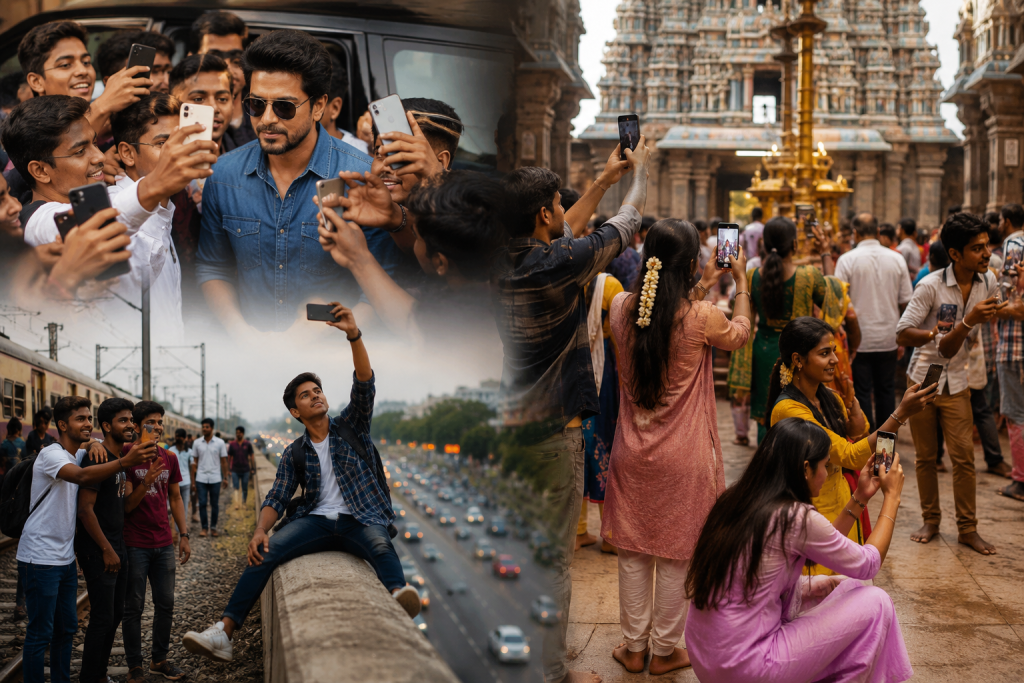
The rise of smartphones and social media has transformed how young people in Tamil Nadu express themselves. What began as a harmless trend of clicking selfies has now evolved into an aggressive “selfie and reel culture,” particularly among youngsters eager for online validation. While creativity and self-expression are welcome, the trend is increasingly raising serious concerns about privacy, consent, and public behaviour.
Across cities like Chennai, Coimbatore, and Madurai, it has become common to see groups of youngsters filming Instagram reels or rushing to click selfies — often without considering the space or comfort of others around them. Public places, restaurants, roads, and even hospitals have become backdrops for content creation, turning everyday environments into performance zones.
Alarmingly, this culture has now entered temples and other spiritual spaces. In places meant for silence, devotion and reflection, many youngsters are seen recording reels, posing for selfies, and even staging videos. Devotees complain that the constant use of mobile phones disrupts the sanctity of these spaces, while some are filmed without consent. What should be a spiritual experience is increasingly becoming a digital spectacle, raising questions about respect for tradition and shared spaces.
The issue becomes more pronounced when it involves celebrities. Actors, politicians, and public figures frequently face crowds pushing, pulling, and invading personal space just to capture a selfie or short video. Even during temple visits, they are often surrounded by people seeking pictures, leaving little room for privacy or peaceful worship. What many consider a “once-in-a-lifetime moment” often turns into a chaotic and uncomfortable experience for the individual at the centre.
“A selfie is no longer just a memory — it has become a social currency,” says media analyst R. Karthik. “The problem begins when validation matters more than basic courtesy.”
Several celebrities have subtly expressed discomfort over such encounters. Many point out that fans no longer ask for permission but assume access. This shift reflects a broader cultural change where digital visibility often overrides personal boundaries.
Psychologists warn that this behaviour is driven by a mix of peer pressure and the fear of missing out (FOMO). “Youngsters today feel compelled to document everything,” explains psychologist Dr. Meena Subramanian. “But they are not always aware of the ethical lines they are crossing, especially when others are involved. When this extends into sacred spaces, it shows a lack of awareness about cultural sensitivity.”
There have also been safety concerns. Instances of youngsters attempting risky selfies on roads, railway tracks, and crowded locations have led to accidents. In temples and crowded events, distracted movement while filming can create dangerous situations, including stampede-like conditions.
“Respecting personal space is a basic social value,” notes sociologist Prof. Arun Prakash. “Digital culture should not erode that. Consent is not optional — it is essential. The same applies to spiritual places — they demand discipline and respect.”
Authorities and event organisers have begun to take note, with stricter crowd control measures and restrictions on mobile usage in some temples. However, experts believe that awareness, not enforcement alone, is the real solution.
The selfie and reel culture is here to stay, but its direction depends on how responsibly it is practised. Striking a balance between expression and respect is crucial, especially in culturally and spiritually significant spaces.
“Take the picture, but don’t take away someone’s dignity,” says a Chennai-based filmmaker. “That’s the line we must not cross.”
As Tamil Nadu’s youth continue to shape digital trends, the need of the hour is simple: enjoy the moment, but respect the person — and the place.