


 United Nations, Dec 24: As the United Nations prepares to celebrate its 80th anniversary next year, India stressed that reform is “key” to the organisation’s “relevance” in addressing current and future global challenges, as world leaders signed off on an ambitious pact in 2024 to transform global governance and drive sustainable action.
When world leaders descended at the UN Headquarters in September for the high-level 79th session of the General Assembly, they adopted by consensus the landmark ‘Pact of the Future’ – a document that covers themes from peace and security, sustainable development to climate change, digital cooperation, human rights, gender, youth and future generations, and transformation of global governance.
Underlining the need for reform, UN Secretary-General Antonio Guterres said, “We don’t need a crystal ball to see that 21st Century challenges require problem-solving mechanisms that are more effective, networked and inclusive. We can’t create a future fit for our grandchildren with systems built for our grandparents.”
India has been at the forefront of years-long efforts calling for reform of the Security Council, including expansion in both its permanent and non-permanent categories, saying the 15-nation Council, founded in 1945, is not fit for purpose in the 21st Century and does not reflect contemporary geo-political realities.
Delhi has underscored that it rightly deserves a permanent seat at the horse-shoe table.
A polarised Security Council has failed to deal with current peace and security challenges, with Council members sharply divided on conflicts such as the Ukraine war and the Israel-Hamas war.
Guterres noted that many of today’s pressing issues were not foreseen when the UN’s multilateral framework was created 80 years ago.
India’s message to the international community was that reforms in global institutions are essential for global peace and development.
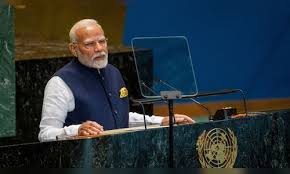
“Reform is the key to relevance… Global action must match global ambition,”Prime Minister Narendra Modi said in his address to the UN’s Summit of the Future, where the Pact was adopted.
Modi’s clarion call for change from the UNGA lectern came amid ongoing global conflicts, including the Ukraine war entering its third year, the Israel-Hamas war, and escalating global threats like terrorism, climate crises, economic inequality, and attacks on women’s rights.
Amid these global challenges, India consistently advocated dialogue and diplomacy to arrive at solutions and resolve conflicts. When Modi met Ukraine’s President Volodymyr Zelenskyy on the sidelines of the Summit of the Future before wrapping up his three-day visit to the US, he reiterated India’s willingness to play a constructive role in the quest for a peaceful resolution of the conflict through dialogue and diplomacy.
Foreign Secretary Vikram Misri emphasised Modi’s commitment to finding a way forward and contributing in any way possible to a resolution of the Russia-Ukraine conflict.
The Modi-Zelenskyy meeting was the third in about as many months. Modi met the Ukrainian leader in Kyiv in August, just weeks after he met Russian President Vladimir Putin in Moscow in July. In June, Modi held a bilateral meeting with Zelenskyy on the sidelines of the G7 Summit in Italy.
Modi held bilateral talks with Palestinian President Mahmoud Abbas, expressing concern over the Gaza crisis and advocating a two-state solution for sustainable peace in the region.
Modi also met Iranian President Masoud Pezeshkian on the sidelines of the 16th BRICS summit in Kazan, Russia in October amidst heightened tensions between Iran and Israel. Modi emphasized the need for dialogue and diplomacy to de-escalate tensions in the volatile region.
Terrorism continued to pose a significant threat to peace and security globally in 2024.
External Affairs Minister S Jaishankar’s General Assembly address in September marked a strong stance, explicitly condemning Pakistan’s “cross-border terrorism policy”for the first time in six years from the UNGA lectern while delivering the national statement at the high-level General Debate.
He asserted that terrorism is antithetical to everything that the world stands for. “When this polity instils such fanaticism among its people, its GDP can only be measured in terms of the radicalisation and its exports in the form of terrorism,”Jaishankar said.
“Pakistan’s cross-border terrorism policy will never succeed. And it can have no expectation of impunity. On the contrary, actions will certainly have consequences. The issue to be resolved between us is now only the vacation of illegally occupied Indian territory by Pakistan. And of course the abandonment of Pakistan’s longstanding attachment to terrorism,” he said.
His statement echoed late External Affairs Minister Sushma Swaraj’s 2018 address, which criticised Pakistan’s continued glorification of terrorism.
“Pakistan’s commitment to terrorism as an instrument of official policy has not abated one bit… Pakistan glorifies killers; it refuses to see the blood of innocents,” Swaraj had said in her powerful takedown of Pakistan from the UNGA podium.
The UN’s ability to maintain peace and security remains under scrutiny as its Security Council grapples with polarisation and fails to maintain international peace and security.
Pakistan, which has an “all-weather ally” in China, is set to sit at the Security Council horse-shoe table for a two-year term as an elected non-permanent member beginning January 1, 2025.
It should come as no surprise that Pakistan will use its UNSC tenure to raise the issue of Jammu and Kashmir and propose discussions at the multilateral forum on the bilateral issue, despite past failures to garner support from the wider UN membership.