


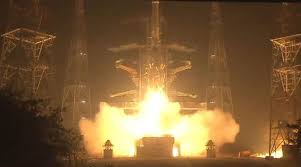
 Sriharikota, Jan 29: In its 100th launch, the Indian Space Research Organization (ISRO), on January 29, successfully placed the NVS-02 navigation satellite into Geosynchronous Transfer Orbit (GTO). GSLV-F15 rocket, which had indigenously developed upper cryogenic separation stage, lifted off from the second launch pad at the Satish Dhawan Space Centre SHAR, Sriharikota.
After a flight of about 20 minutes, the NVS-02 satellite was injected into the GTO. ISRO will conduct orbit-raising manoeuvres to take the satellite to the intended Geosynchronous orbit. The 50m tall rocket with a lift off mass of 420.7 ton blasted off at 6.23 am. Travelling at a velocity of 9,707.23 metres per second during the cryogenic stage, the rocket dropped off the satellite at an altitude of 322.93km.
As per the space research organization, GSLV-F15 was the 17th flight of India’s GSLV and 11th flight with indigenous cryogenic stage. GSLV-F15 is the operational flight of GSLV with an indigenous cryogenic stage.
NVS-02, which is about 2,250kg and the second satellite in the NVS series, is configured with navigation payload in L1, L5 and S band in addition to ranging payload in C-band. After the required orbit-raising manoeuvres, the NVS-02 will be placed in Geosynchronous orbit to replace IRNSS-1E that was launched on January 20, 2016. NVS-02 will augment Navigation with Indian Constellation (NavIC).
NavIC is India’s independent regional navigation satellite system designed to provide accurate position, velocity and timing (PNT) service to users in India as well as to regions extending about 1500km beyond Indian landmass.
NavIC will provide two types of services, namely, Standard Positioning Service (SPS) and Restricted Service (RS). NavIC’s SPS provides a position accuracy of better than 20m and timing accuracy better than 40 nanoseconds over the service area. NVS-02 uses a combination of indigenous and procured atomic clocks for precise time estimation.
ISRO has planned to launch five second-generation NavIC satellites including NVS-01 and NVS-02.Other three satellites will be launched in future missions.
The IRNSS series of seven satellites, which are the first generation NavIC satellites, were launched between July 1, 2013 and April 12, 2018. A few months ago, Science and Technology minister Jitendra Singh, a few months ago, informed the Parliament that three of the seven IRNSS NavIC satellites failed and the PNT services are provided by the remaining 4 satellites.
Key applications of NavIC service include, navigation, precision agriculture, fleet management, location-based services in mobile devices, Internet-of-Things (IOT) based applications and others.