


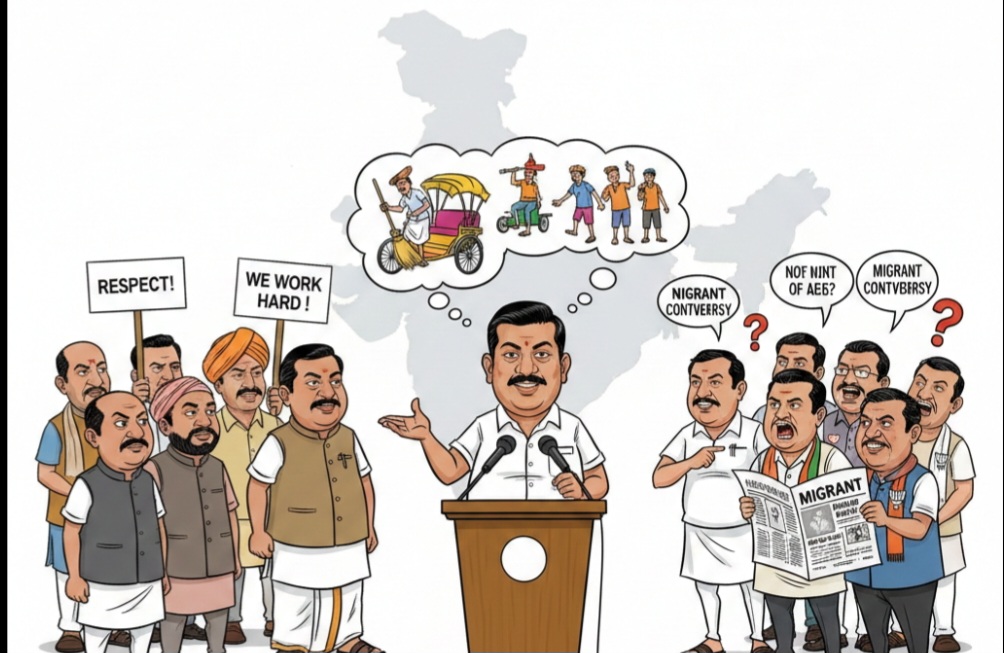

Migrant Labour, a Minister’s Remark, and the Facts We Prefer Not to See
A recent remark by Tamil Nadu minister MRK Panneerselvam, describing North Indian migrants in dismissive occupational terms, triggered an entirely predictable political exchange. The BJP responded with outrage, framing the comment as an insult to migrant workers and a slur on national unity. Television panels warmed up. Social media took sides. Words hardened quickly.
But as often happens, the noise raced ahead of understanding.
Lost in the controversy was the more uncomfortable question the remark inadvertently raised: who are these migrant workers in Tamil Nadu, how many are there, why are they here, and what role do they play in the state’s economy? Before judging the language, it is worth examining the reality it clumsily gestured at.
The Limits of Counting, and Why They Matter
India does not maintain a real-time registry of internal migrant workers. There is no annual ledger of who arrived where, from which state, and for how long. Any serious discussion must therefore begin by rejecting false precision.
What is available in the public domain are broad indicators: place-of-last-residence data, duration-of-stay categories, and periodic labour force surveys. Together, they allow us to identify patterns, not headcounts.
Those patterns are unambiguous. Over the past decade, Tamil Nadu has consolidated its position as one of India’s major destinations for inter-state labour migration. This is not a recent surge triggered by a single sector, nor a temporary influx. It is structural.
Workers arrive predominantly from eastern and central parts of the country — regions where employment outside agriculture remains limited and incomes volatile. Migration to Tamil Nadu is therefore not episodic desperation; it is a calculated economic choice sustained by networks, contractors, and repeat cycles.
Who Migrates: The Human Profile
The typical migrant worker in Tamil Nadu is young, mobile, and in prime working age. This is not incidental. Labour markets demand physical stamina; migrants seek maximum earning years.
Men dominate labour-driven migration, though women are far from absent. Female migrants are present in specific sectors and, increasingly, in longer-stay family arrangements. Many households live split lives: one or two members work in Tamil Nadu while families remain in the home district.
This pattern produces what might be called a “two-home economy”. Earnings are generated in one state, consumed and invested in another. Migration here is not abandonment of roots but extension of them.
Why Tamil Nadu Pulls Workers In
Migration is best understood as an equation, not a moral tale. On the sending side lie familiar pressures: shrinking farm viability, seasonal employment gaps, debt cycles, and limited industrial absorption. On the receiving side, Tamil Nadu offers something more stable — continuous demand.
The state’s economic structure is labour-intensive. Construction, small manufacturing, logistics, hospitality, and infrastructure maintenance operate year-round. They cannot pause for local labour shortages or demographic discomfort. Projects require hands, predictably and repeatedly. Once established, migration routes become self-reinforcing. Contractors recruit through kinship and village networks. Information flows faster than policy. A worker who succeeds brings others. The pipeline, once open, rarely closes.
What Work Is Actually Being Done
Political shorthand often reduces migrant labour to a caricature of menial work. Reality is broader and more complex.
Migrant workers form the backbone of construction activity: masonry, reinforcement, scaffolding, material handling. In industrial clusters, they operate machines, manage assembly lines, and staff night shifts. Logistics hubs rely on them for loading, sorting, and last-mile movement.
In hospitality and food services, migrant labour sustains the back-end ecosystem — cleaning, preparation, dishwashing, inventory management, delivery. These roles are physically demanding, time-bound, and poorly glamorised, yet indispensable.
Many such jobs are casually labelled “unskilled”. This is misleading. They require task-specific expertise learned through repetition rather than certification. Skill exists here; it simply lacks validation by paperwork.
Where They Live: The Geography of Labour
Migrant labour follows industry, not sentiment.
Concentrations are highest in urban and peri-urban belts: metropolitan regions, industrial corridors, logistics zones, and port-linked areas. Housing reflects income insecurity and mobility. Workers live in dormitories near worksites, shared rooms in dense neighbourhoods, or temporary camps adjoining industrial estates.
These spaces are largely invisible to the wider city. Migrant settlements do not announce themselves; they are noticed mainly during crises. Spatial invisibility reinforces social invisibility.
Access to sanitation, healthcare, and secure tenancy varies widely. Stability improves with length of stay, but precarity remains the default condition.
Contribution Without Applause
Tamil Nadu’s growth over the past decade has depended quietly on migrant labour. Infrastructure expansion, real estate development, manufacturing continuity, and service-sector scalability would be difficult to sustain without it. This is not a sentimental claim; it is an operational one. Projects do not complete themselves. Warehouses do not load overnight. Kitchens do not reset after midnight without human effort.
Yet public recognition of this contribution remains thin. Migrant labour is spoken of either as a number or as a problem — rarely as an economic pillar.
Temporary Presence, Permanent Anxiety
A persistent source of anxiety is the assumption that migrant workers represent permanent demographic change. In practice, much of this workforce is mobile by design. Many workers intend to return home. Many do, cyclically.
This mobility explains why civic integration appears shallow. It is not resistance; it is rational behaviour. When life is split across geographies, deep local embedding is neither immediate nor always sought.
Why the Remark Resonated
The minister’s remark resonated not because it revealed a hidden truth, but because it echoed a familiar discomfort. Tamil Nadu depends on migrant labour while remaining uneasy about acknowledging that dependence openly. The economy absorbs these workers efficiently. Society does so unevenly. Politics addresses them selectively, often through language that flattens complexity into stereotype.
Before outrage hardens into posture, it is worth holding on to the first, simplest fact — the one most easily forgotten amid controversy:
Tamil Nadu works because people from elsewhere work here.
Understanding that reality is not a concession. It is the starting point for any honest conversation.