


Chennai, May 29:
In a significant scientific breakthrough, the Dual Frequency Synthetic Aperture Radar (DFSAR) onboard India’s second lunar mission, Chandrayaan-2, has detected signs of subsurface ice in the Moon’s South Polar Region. The Indian Space Research Organisation (ISRO) said the findings offer major insights into the distribution of lunar polar volatiles and could play an important role in future lunar exploration and resource utilisation missions.
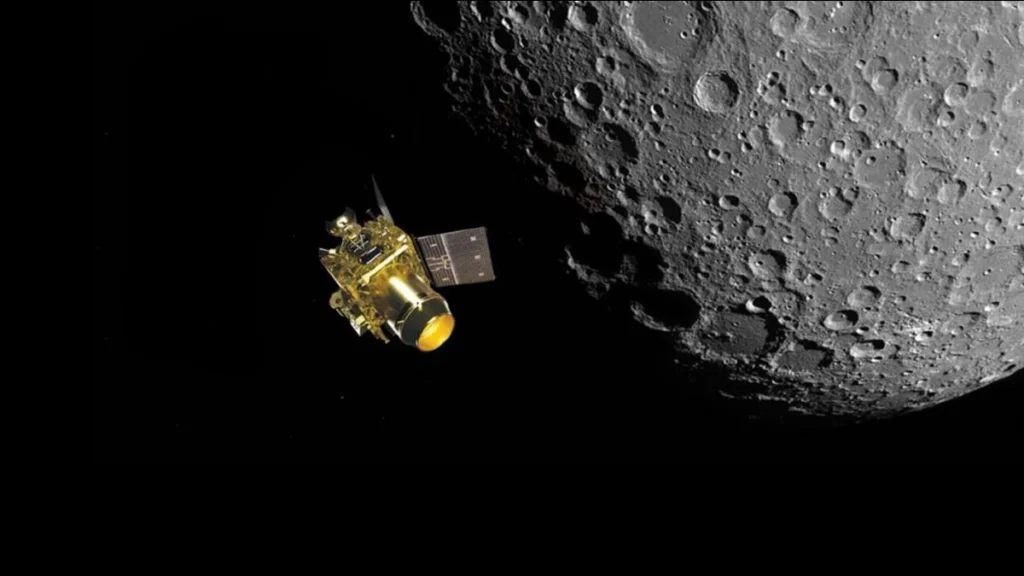
Chandrayaan-2 was launched on July 22, 2019, aboard the GSLV Mk III-M1 rocket from Sriharikota. After a series of Earth-bound and lunar orbit manoeuvres, the spacecraft successfully entered the Moon’s orbit. While communication with the Vikram lander was lost during its landing attempt in September 2019, the orbiter has remained healthy and continues to function with all payloads operational. Chandrayaan-2 carries eight scientific payloads aimed at studying the Moon’s geology, composition, and exosphere.
According to ISRO, scientists from the Physical Research Laboratory (PRL), Ahmedabad, conducted a detailed investigation of the lunar South Polar Region using DFSAR observations. The instrument, operating in L and S-band microwave frequencies, is the first fully polarimetric Synthetic Aperture Radar sent to study the Moon. The study focused on “doubly shadowed craters” located within permanently shadowed regions, where temperatures can drop below minus 25 Kelvin, making them ideal locations for preserving water ice over billions of years.
Using advanced radar polarimetric analysis, scientists identified radar signatures suggesting the possible presence of subsurface ice beneath the floors of four doubly shadowed craters. Researchers used a refined radar-based criterion where Circular Polarization Ratio values greater than 1 and Degree of Polarization values lower than 0.13 indicated volumetric scattering associated with possible ice deposits beneath the surface. This method also helped distinguish actual ice signatures from signals caused by rough rocky terrain.
Among the craters studied, a 1.1-km-wide crater located within the Faustini crater displayed particularly strong evidence of subsurface ice. Scientists said the crater also showed distinctive “lobate-rim” morphological features, which resemble flow-like structures and suggest that the impact event may have penetrated ice-rich subsurface layers.
ISRO said the findings are expected to support future lunar landing missions and in-situ resource utilisation activities by helping identify potential ice-bearing regions on the Moon.