


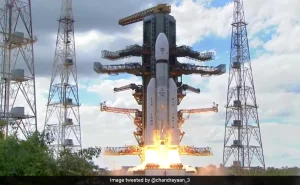
 Sriharikota: India’s Chandrayaan-3 lifted off from Sriharikota in Andhra Pradesh, carrying the hopes of an entire nation.
The journey from Earth to the moon for the spacecraft is estimated to take about a month and the landing is expected on August 23. Upon landing, it will operate for one lunar day, which is approximately 14 Earth days. One day on the Moon is equal to 14 days on Earth.
The Chandrayaan-3 will have three major components — a lander, a rover, and a propulsion model. It will be using the Orbiter from Chandrayaan-2 which still exists in the lunar atmosphere.
In a first, India’s mooncraft ‘Vikram’ will land in the South Pole of the moon, where water molecules have been found. The finding, made during India’s first moon mission in 2008, had startled the world.
Chandrayaan, which means “moon vehicle” in Sanskrit, includes a 2 metres (6.6 feet) tall lander designed to deploy a rover near the lunar south pole, where it is expected to remain functional for two weeks running a series of experiments. The launch is India’s first major mission since Prime Minister Narendra Modi’s government announced policies to spur investment in space launches and related satellite-based businesses. Since 2020, when India opened to private launches, the number of space startups has more than doubled. Late last year, Skyroot Aerospace, whose investors include Singapore’s sovereign wealth fund GIC, launched India’s first privately built rocket. “Joining a billion Indians in wishing great luck for #Chandrayaan3 mission!” Skyroot co-founder Pawan Chandana said in a tweet.