


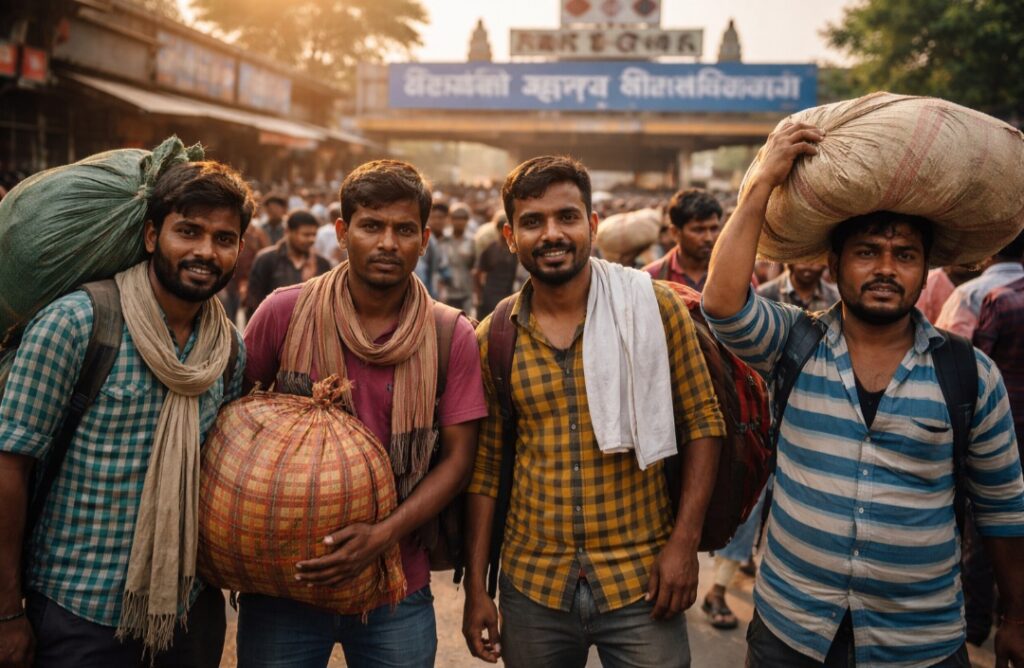
Migrant Labour & Politics of Speech
The controversy sparked by a Tamil Nadu minister’s remark about migrant workers did not erupt because it was unprecedented. It erupted because it was familiar. The phrasing may have been crude, but the sentiment it revealed has long existed in a more polite form: migrant labour is welcome for work, uncomfortable as presence, and expendable in speech.
The BJP’s response, swift and indignant, framed the comment as an insult to migrant dignity and national unity. The exchange followed a script now well rehearsed. But scripts are precisely what deserve scrutiny, because they simplify realities that are anything but simple.
The Convenience of the Phrase “North Indian”
Political language thrives on shortcuts. Few are as blunt — or as misleading — as the phrase “North Indian”.
It collapses multiple regions, languages, castes, and economic histories into a single identity. Workers from eastern, central, and northern districts are lumped together, stripped of specificity, and rendered interchangeable. This flattening serves rhetoric well. It serves understanding poorly.
Such language does more than misdescribe. It enables stereotyping. Once reduced to a monolith, a workforce can be caricatured, blamed, or defended without engaging with its actual composition. Complexity disappears; convenience remains.
Speech as Signal, Not Slip
It is tempting to treat controversial remarks as slips of the tongue. That temptation should be resisted.
Public speech by those in office is rarely accidental. Even when inelegant, it reflects assumptions about what can be said without cost. The remark resonated not because it introduced a new idea, but because it echoed a long-standing unease — the discomfort of acknowledging dependence on labour that is seen as external to cultural identity.
The backlash, equally, was not about labour alone. It was about political positioning. Migrant workers have become a useful symbol: proof of national integration when convenient, evidence of regional insularity when opposed. Neither posture requires sustained engagement with the workers’ actual lives.
The Persistent Fear: Do They Vote Here?
No discussion of migrant labour now proceeds without an undercurrent of electoral suspicion. Do these workers vote? Are voter rolls being altered? Is demographic change being smuggled in through labour mobility?
The facts are prosaic. Voting rights are tied to residence and formal registration. Most migrant workers retain their electoral identity in their home states. Many return to vote. Others do not. A smaller number, particularly longer-stay migrants, may shift registration over time.
What fuels anxiety is not evidence, but imagination. Migration becomes a proxy for electoral fear, especially in periods of political uncertainty. The worker is no longer a labourer; he becomes a hypothetical voter. Suspicion thrives where verification is absent.
Invisibility as Policy Outcome
Migrant workers occupy an odd position in Tamil Nadu’s governance landscape. They are visible enough to be blamed, invisible enough to be ignored.
Wage disputes, workplace injuries, and exploitative contracting practices persist not because laws do not exist, but because enforcement assumes permanence. Circular migrants fall through institutional gaps. Welfare portability remains partial. Language barriers compound isolation.
This invisibility is not accidental. It suits multiple actors. Employers benefit from pliability. Contractors benefit from opacity. Politicians benefit from distance. Responsibility disperses; accountability dissolves.
A Long History of Unease
Tamil Nadu’s relationship with “outsiders” has always been complicated. Identity politics here has been shaped by language, culture, and historical grievance. Economic migration sits uneasily within this framework.
Over time, vocabulary has softened. “Outsider” gave way to “guest worker”. But the underlying tension remains. Guests are welcomed, but not expected to stay. They are appreciated, but not embraced. The language may be courteous; the boundary is firm.
The current controversy fits neatly into this continuum. It is not an aberration. It is a reminder.
The Double Standard at the Heart of Growth
There is a contradiction at the centre of Tamil Nadu’s development story. Growth is celebrated; the labour enabling it is often resented.
Migrant workers are essential to construction, logistics, manufacturing, and services. Their absence is felt immediately. Yet their presence is discussed reluctantly. The economy counts on them. Public discourse keeps them at arm’s length.
This double standard manifests most starkly in moments of speech. Praise is reserved for abstract growth. Critique is directed at visible labour. The link between the two is rarely acknowledged openly.
Politics Without Solutions
The controversy revealed another pattern: the ease with which migrant labour becomes a talking point, and the difficulty of turning that talk into policy.
Outrage travels faster than administration. Statements are issued. Rebuttals follow. But questions of housing standards, health access, contractor regulation, and grievance redress remain peripheral.
Both sides of the political divide benefit from keeping the debate symbolic. One side invokes dignity without detailing protection. The other invokes identity without addressing dependence. Workers remain central to the argument, marginal to the outcome.
What Serious Governance Would Require
A mature response to migrant labour does not begin with slogans. It begins with data that is collected without paranoia and used without prejudice.
It requires recognising mobility as a feature of the modern economy, not a threat to it. It demands worker facilitation centres, enforceable housing norms, portable welfare mechanisms, and accountability within contracting chains.
Most of all, it requires discipline in speech. Language shapes policy climates. Casual contempt legitimises neglect. Respect, when consistent, enables reform.
The Real Question
The controversy will fade, as such controversies do. Another will replace it. What will persist is the underlying question Tamil Nadu must answer for itself.
Not whether migrant workers are welcome — the economy has already answered that.
Not whether they belong — many do not seek belonging in the cultural sense.
But how a modern state chooses to speak about those who build it.
Because speech is never merely speech. It is a preview of priorities. And in that preview lies the difference between a workforce that is merely used and one that is at least acknowledged.