


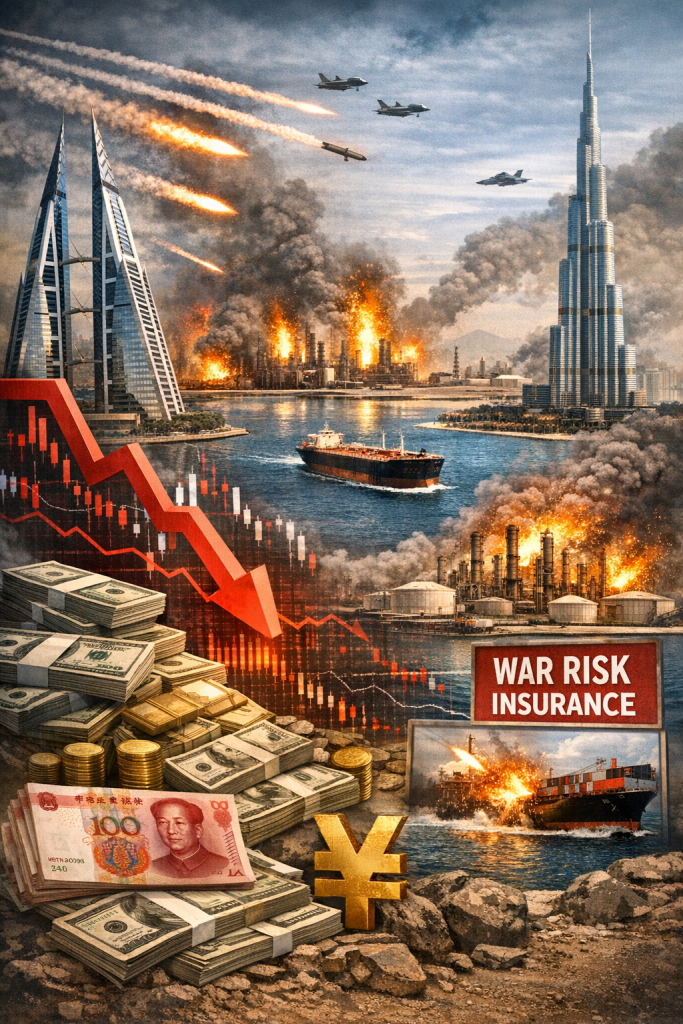
Three weeks into the US-Israel campaign against Iran, the Persian Gulf’s financial machine—long a beacon of stability amid oil wealth—finds itself squarely in the line of fire.
Missile strikes on energy hubs from South Pars to Ras Laffan, partial closure of the Strait of Hormuz and retaliatory hits on Gulf ports have frozen trade finance, spiked insurance costs and triggered fears of deposit runs.
While pre-war capital cushions remain thick, the region’s banks, once insulated by sovereign backstops and petrodollar flows, now confront rising bad debts, liquidity strains and a potential currency reckoning that could reshape the global financial order.
Gulf Banks Brace for Deposit Flight
Gulf lenders entered the conflict from a position of strength, boasting average Tier-1 capital ratios near 17 percent and non-performing loan levels below 3 percent. Yet the speed of disruption has rattled confidence.
Ratings agencies warn that a prolonged conflict could spark domestic deposit outflows of up to $307 billion across the six GCC banking systems—roughly 10 percent of total deposits based on year-end 2025 figures.
So far outflows remain contained, but flight-to-quality moves between local banks and external withdrawals are already evident in overnight funding markets.
Trade finance lines for oil shipments and logistics have been hit hardest. Letters of credit for tankers idling near Hormuz are being renegotiated or cancelled outright. Real-estate and hospitality loans, heavy in Dubai and Abu Dhabi portfolios, face early stress as tourism bookings evaporate and construction timelines slip.
Energy-sector exposures, which form 20-30 percent of many bank books, benefit temporarily from oil above $100 a barrel, but any sustained production halts will quickly translate into payment delays and higher provisioning.
Bahrain and Dubai: Hubs Hit Hardest
Bahrain, the region’s offshore banking centre, stands out as the most vulnerable. Its retail banks carry higher external debt loads and thinner liquidity buffers than UAE or Saudi peers.
A stress scenario of significant outflows could force reliance on regional support, echoing past episodes but with tighter fiscal room this time.
Dubai’s DIFC, meanwhile, has seen hedge funds and international desks activate contingency plans—remote work, data backups outside the Gulf and even temporary staff relocations.
The emirate’s stock exchange has fluctuated sharply, with country risk premiums rising 12 basis points in the first fortnight alone. Yet both hubs retain deep sovereign ties; regulators have stepped up supervision and signalled readiness to inject liquidity if needed.
Bad Debts Loom in Energy and Trade
The real test lies in asset quality. Under a hypothetical stress test assuming either a 50 percent jump in non-performing loans or an overall NPL ratio reaching 7 percent—whichever is greater—cumulative losses across the top 45 GCC banks could hit $37 billion.
That would still leave most institutions solvent thanks to existing coverage ratios above 150 percent, but weaker names in tourism, shipping and small-business segments could require forbearance measures similar to those deployed during COVID.
International banks with Gulf exposure, particularly Asian lenders who extended record loans last year, are quietly reassessing limits. Chinese and Indian institutions hold billions in project finance tied to infrastructure now at risk from delayed payments or force-majeure claims.
Insurance Industry’s War-Risk Reckoning
Marine and political-risk insurers have absorbed the sharpest immediate blow.
War-risk premiums for vessels in the Persian Gulf have exploded from 0.25 percent of hull value pre-conflict to 1 percent or higher in many cases—sometimes reaching 3 percent for single voyages through or near the strait.
For a typical $200 million tanker, that translates into an extra $7 million per trip. Some underwriters have issued notices of cancellation, forcing shippers to scramble for cover or reroute entirely.
Cargo war-risk rates have followed suit, reviewed voyage-by-voyage. Reinsurers are tightening capacity, pushing primary premiums even higher.
The surge has turned what was once a routine cost into a make-or-break line item, amplifying freight rates and further squeezing trade finance availability.
Currency Shifts: Dollar vs. Yuan Showdown
The conflict has also accelerated subtle but profound shifts in currency markets. Iran’s reported willingness to allow tanker passage through Hormuz only for cargoes settled in Chinese yuan has put fresh pressure on the petrodollar regime.
While most Gulf oil sales still price in dollars, Beijing’s growing role as the region’s largest buyer gives the yuan credible traction.
Reports of selective yuan-denominated deals have already surfaced, and analysts note this could mark the beginning of a broader “petroyuan” experiment if the conflict drags on.
The dollar has held firm so far—bolstered by safe-haven flows—but sustained disruption risks widening basis swaps and testing swap-line arrangements for European and Asian banks hungry for dollar liquidity.
Gulf sovereign wealth funds, meanwhile, continue diversifying reserves, quietly adding non-dollar assets as a hedge.
Global Ripples Through International Exposures
Beyond the Gulf, international banks with cross-border loans to the region face indirect hits.
European and US institutions with exposure to commodity traders and shipping firms are tightening credit lines, while Asian lenders reassess their aggressive push into Gulf project finance. L
Stock exchanges from London to Singapore have seen volatility spill over into energy and financial stocks. Global payment systems remain operational, yet delays in correspondent banking for Gulf clients have raised settlement risks.
The conflict has underscored the region’s centrality to global finance: any lasting erosion of its safe-haven image could prompt a gradual reallocation of capital toward more stable hubs in Asia and Europe.
In the end, Gulf banks have proved resilient in the opening rounds, thanks to strong buffers and swift regulatory support.
Yet the longer the missiles fly and the strait stays contested, the greater the chance that today’s manageable strains harden into structural shifts—higher risk weights on energy loans, accelerated digital trade finance platforms and a slow unwinding of dollar dominance in parts of the oil trade.
For now the region’s financial engine still turns, but the gears are grinding under pressure.
In the harsh arithmetic of modern conflict, even the bankers who once profited from stability are learning that war extracts its own premium—and someone always pays.