


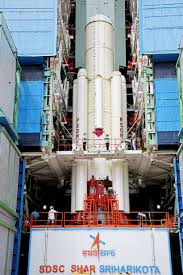
 Chennai: After a subdued 2021 hit by the Covid pandemic, the Indian Space Research Organisation (ISRO) will be launching its first mission of 2022 when PSLV-C52 will take to skies carrying the 1,710 kg Earth Observation Satellite (EOS-04) and two small satellites from the spaceport of Sriharikota on 14 February.
Sources said the workhorse launch vehicle PSLV-C52 will lift off from the First Launch Pad at 0559 hours on February 14 from the Satish Dhawan Space Centre, Sriharikota.
This will be the first launch for ISRO under its new Chairman S Somanath, who took over from Dr K Sivan last month.
The 25 hours and 30 minutes countdown leading to the launch would commence at 4.29 am on 13 February after the Launch Authorization Board clears the mission.
PSLV-C52 is designed to orbit an earth observation satellite (EOS-04), weighing 1,710 kg into a sun synchronous polar orbit of 529 km.
PSLV-C52 mission will also carry two small satellites as co-passengers which includes one student satellite (INSPIREsat-1) from Indian Institute of Space Science and Technology (IIST) in association with Laboratory of Atmospheric and Space Physics at University of Colorado, Boulder.
The other satellite will be a technology demonstrator satellite (INS-2TD) from ISRO, which is a precursor to India-Bhutan Joint Satellite (INS-2B).
EOS-04 is a Radar Imaging Satellite designed to provide high quality images under all weather conditions for applications such as Agriculture, Forestry & Plantations, Soil Moisture and Hydrology and Flood mapping.
This will be the first PSLV mission in the last one year after PSLV-C52’s predecessor PSLV-C51 successfully launched Amazonia-1 and 18 co-passenger satellites in the first dedicated launch by NSIL on 28 February last year.
Its another mission, GSLV-F1-/EOS-03 mission on 12 August was unsuccessful after the third tage–the cyrogenic stage–failed to get ignited.
ISRO had two missions in 2021 in which one was a dedicated commercial mission by NSIL. The GSLV-F10/EOS-03 mission failed due to cryogenic stage anomaly.
A national level failure analysis committee was constituted for the same and the committee has identified the root cause and given its recommendations. Necessary design changes are being incorporated to improve the robustness of concerned systems, Dr Sivan said.
The GSLV-F10, carrying the Earth Observation Satellite, EOS-03, took off from the SHAR Range, Sriharikota on 12 August, 2021 at 0543 hrs as scheduled. The performance of first and second stages was normal. However, the Cryogenic Upper Stage ignition did not happen due to technical anomaly and the mission could not be accomplished as intended.